

Schedule your pre-season tire appointment with our team
Brattleboro's foliage season is gorgeous, and it's also when the trouble starts. Overnight lows in October regularly dip into the upper 30s here, and your standard M+S all-season tire's rubber compound begins stiffening at 45 degrees F. Below that threshold, Michelin's own technical guidance confirms, grip starts dropping on every surface, not just snow. The snow might not arrive until November in earnest, but the compound problem shows up with apple cider season. Tire marketing rarely mentions that part.
Three-Peak Mountain Snowflake (3PMSF) rated tires solve that temperature problem first and the snow problem second. We'll walk you through which category fits the roads you actually drive, the vehicle you're driving it in, and the winter you're planning for.
The short version
- A plain M+S marking is a tread geometry label, not a cold-weather performance test. It does not mean the rubber stays pliable in genuine Vermont cold.
- The 3PMSF symbol means the tire passed a standardized acceleration test on medium-packed snow and scored at least 10% better than a reference tire. That is a real, tested result.
- For most Brattleboro-area commuters and family drivers, a 3PMSF-rated all-weather tire is a strong year-round choice. You get certified winter grip without swapping tires twice a year.
- If you're on unplowed dirt town roads frequently, or driving into the hills above Guilford and Putney after a hard storm, a dedicated studless winter tire (also carries the 3PMSF symbol) will beat any all-weather in that worst 10% of conditions.
- Vermont allows studded tires year-round under state law, but check regulations if you cross into New Hampshire or Massachusetts on that commute to Keene.
What Actually Matters When Choosing a 3PMSF-Rated Tire?
The 3PMSF symbol narrows the field, though it won't make the decision for you, because four variables separate a tire that works well in our market from one that only technically qualifies, and knowing them up front keeps you from buying the right symbol on the wrong tire.
| Variable | Why It Matters Here | What to Look For | Honest Tradeoff |
|---|---|---|---|
| Rubber compound cold threshold | All-season rubber stiffens below 45 degrees F, reducing grip before any snow falls | A compound rated to stay flexible well below 32 degrees F | Softer cold-weather compounds wear faster in summer heat |
| What the 3PMSF test actually measures | The certification tests forward acceleration traction on medium-packed snow only; braking and lateral grip are not part of the ASTM standard | Look for manufacturer ice-grip data beyond the basic symbol | A tire can pass 3PMSF and still be average on ice (the symbol is a floor, not a ceiling) |
| All-weather vs. dedicated winter | All-weather tires carry the 3PMSF symbol and can run year-round; dedicated winter tires also carry it but use an even softer compound optimized for cold | Match the tire category to your winter severity | Dedicated winter tires degrade faster in summer; all-weather tires don't peak as high in deep cold |
| Drive configuration | AWD and 4WD help you move; they do not help you stop or turn | All four tires should match in category. One winter tire on one axle is worse than no swap at all. | AWD with all-season tires on three wheels and a snow tire on one is genuinely counterproductive |
The certification standard, established by the U.S. Tire Manufacturers Association (USTMA), requires a score of at least 110 on a snow traction index, meaning the candidate tire must outperform a standardized reference tire by at least 10% on medium-packed snow. That test is meaningful. The test leaves a few things out, though. Braking distance, cornering on ice, and lateral grip aren't measured by the ASTM F1805 protocol. The symbol tells you the tire gets going in snow. Stopping is another matter.
The Temperature Reality Southern Vermont Drivers Feel in September
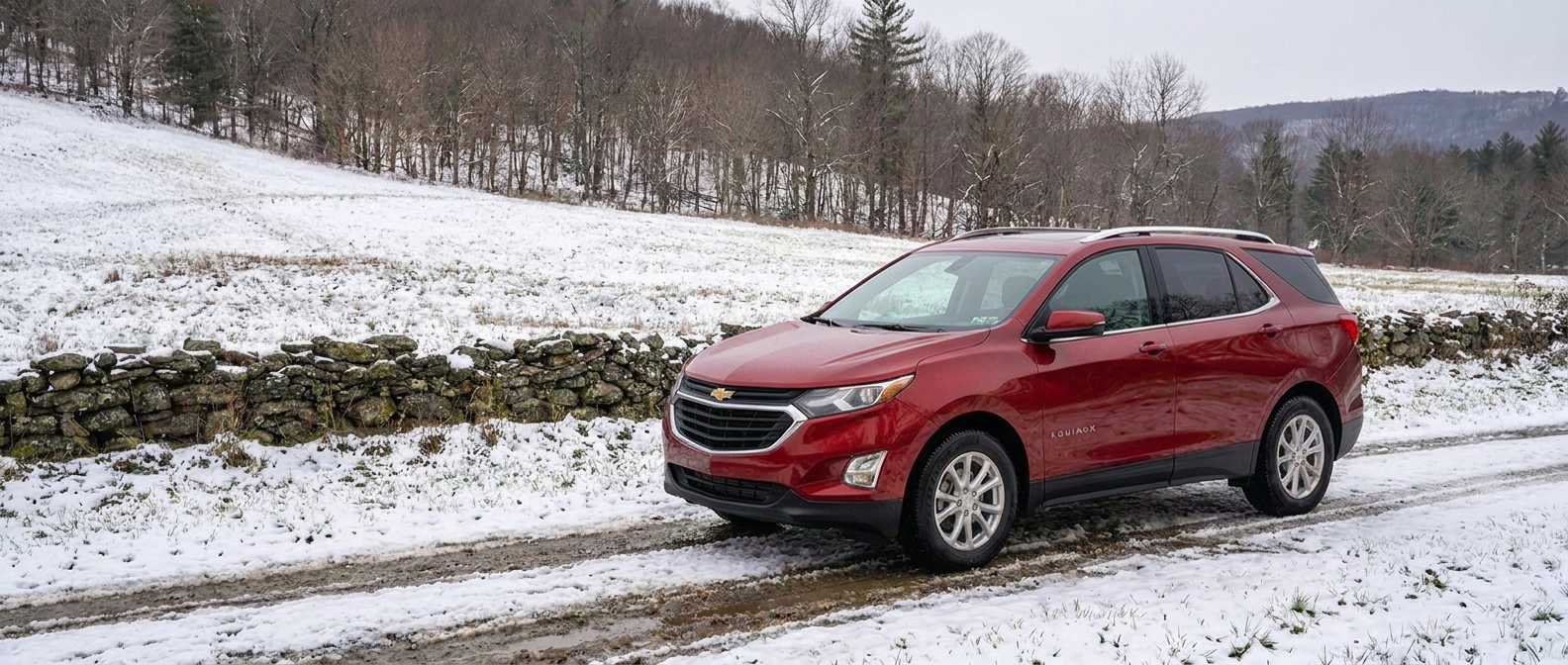
The Equinox's AWD system is already doing real work by the time those late-September overnight lows slide down into the 30s, but AWD is a mobility system, not a traction system in the tire sense, so the tires are still your only contact patch with the road.
Check the overnight lows, not the snow totals. The rubber compound limitation arrives before the snow does, and Michelin's published tire guidance is direct on this. All-season rubber begins stiffening at 45 degrees F, reducing grip on cold, dry roads before any snow appears. Brattleboro's January average low runs around 13 degrees F. The overnight low drops below the 45 degrees F threshold reliably starting in October. So a standard M+S tire is already operating outside its optimal compound range on your morning commute to Brattleboro Memorial Hospital or the school run to Brattleboro Union High School, even on dry pavement, weeks before the first plowable storm.
The 3PMSF rubber compound stays flexible in genuine Vermont cold; a plain M+S all-season tire begins stiffening at 45 degrees F, which in Brattleboro arrives reliably in October, before the first snow.
A 3PMSF-rated all-weather tire uses a compound formulated to stay flexible at cold temperatures, addressing that fall and winter grip loss. A dedicated studless winter tire pushes the cold-performance ceiling even higher, using an even softer silica-enriched compound and thousands of micro-sipes designed to evacuate the thin water film on ice. Both carry the 3PMSF mark. They aren't the same product.
What we see in the service lane. When vehicles roll in on standard M+S tires heading into October in this part of Windham County, the compound hardening is a real concern on our road mix (salted state routes, unplowed Putney-area dirt roads, and everything in between). The 3PMSF requirement isn't a technicality here. The driving calendar makes it relevant starting in September.
Pros and Cons of Each 3PMSF Tire Category
Both all-weather and dedicated winter tires earn the 3PMSF certification, so the choice between them comes down to how severe your winter runs and whether you want to manage two seasonal tire sets, which is more a question of your roads and your patience than of the symbol stamped on the sidewall.
| Pros | Cons |
|---|---|
| All-weather / 3PMSF all-season: Year-round use, no seasonal swap | Softer than a summer tire in August heat; wears faster if summers are hot |
| All-weather / 3PMSF all-season: Certified winter grip without a second set of wheels | Doesn't match a dedicated winter tire in the worst 10% of conditions (hard pack, glare ice, deep slush on unplowed back roads) |
| Dedicated studless winter tire (also 3PMSF): Best cold-weather compound available; shortest stopping distances on ice and packed snow | Needs to come off in spring; running them into summer degrades both the compound and the tread quickly |
| Dedicated studless winter tire (also 3PMSF): Ideal for consistent severe-winter driving (hill routes, unplowed roads, frequent overnight travel in storms) | Requires a second set of wheels or seasonal mounting costs |
| Studded winter tire (Vermont-legal year-round): Adds mechanical grip on glare ice beyond any studless option | Significantly noisier on dry pavement; can damage road surfaces; check NH and MA regulations before crossing state lines |
Match the Gear to How You Actually Drive
A Traverse loaded for a weekend of ski gear and three-row passengers is a different tire conversation than a Colorado running landscaping supplies down a dirt town road in February, and while both vehicles benefit from a 3PMSF-rated tire, they may not need the same category.
For a family commuter driving paved state routes (the run from West Brattleboro to downtown, the push out Route 30 toward Newfane, the commute across the river into Keene) a 3PMSF-rated all-weather tire covers the season without a swap. You get certified cold-weather compound performance from October through mud season without pulling the wheels twice. An all-weather tire still won't match a dedicated winter tire on hard-packed ice. Full stop.
For a driver who regularly uses unpaved town roads that don't get plowed until late morning, or who makes winter runs up into the hills in Springfield, a dedicated studless winter tire on a second set of wheels is worth the extra logistics. The performance gap on hard-packed snow and ice is real. Tire Rack's independent testing found winter tires stopped in 59 feet from 30 mph on packed snow, compared to 89 feet for all-season tires. That 30-foot difference isn't theoretical on a snow-covered Windham County back road.
Winter fundamentals:
- AWD and 4WD help you move; they are aids only
- Reduced speed and increased following distance remain your job in winter conditions
- No tire, at any rating, replaces the physics of slippery roads
One more thing on New Hampshire. Vermont permits studded tires under state law. New Hampshire allows them seasonally (roughly October through May). If your regular commute takes you into Keene, studded tires are an option in both states. Confirm the current dates with the relevant state DMV before mounting them, because those windows get adjusted.
Frequently Asked Questions
Does my Chevrolet's AWD mean I don't need 3PMSF-rated tires?
AWD and 4WD improve your vehicle's ability to accelerate and move on slippery surfaces, but they don't improve braking or cornering grip. Those depend entirely on the tires. Michelin's guidance is clear: even with AWD, you need winter-certified tires on all four wheels for balanced traction and control. An AWD vehicle on plain M+S all-season tires will accelerate better than a two-wheel-drive on the same tires, but its stopping distance and cornering behavior in cold, snowy conditions are governed by the rubber compound, not the drivetrain. In Brattleboro's real winters, that compound question matters from October onward.
What's the difference between a 3PMSF all-weather tire and a dedicated winter tire?
Both carry the 3PMSF snowflake symbol, and both beat a standard M+S all-season tire in cold weather. The difference is compound depth and year-round usability. An all-weather tire is engineered to run year-round. It handles summer heat and certified winter cold without degrading quickly in either direction. A dedicated studless winter tire uses a softer, silica-richer compound optimized for cold performance. It delivers shorter stopping distances on ice and packed snow, but it wears faster in summer temperatures and needs to be swapped off in spring. For most Brattleboro-area drivers on paved routes, an all-weather 3PMSF tire covers the season well. For drivers on unplowed dirt roads, or anyone making frequent winter runs in serious storm conditions, the dedicated winter tire's performance advantage in that worst-case scenario is genuine.