

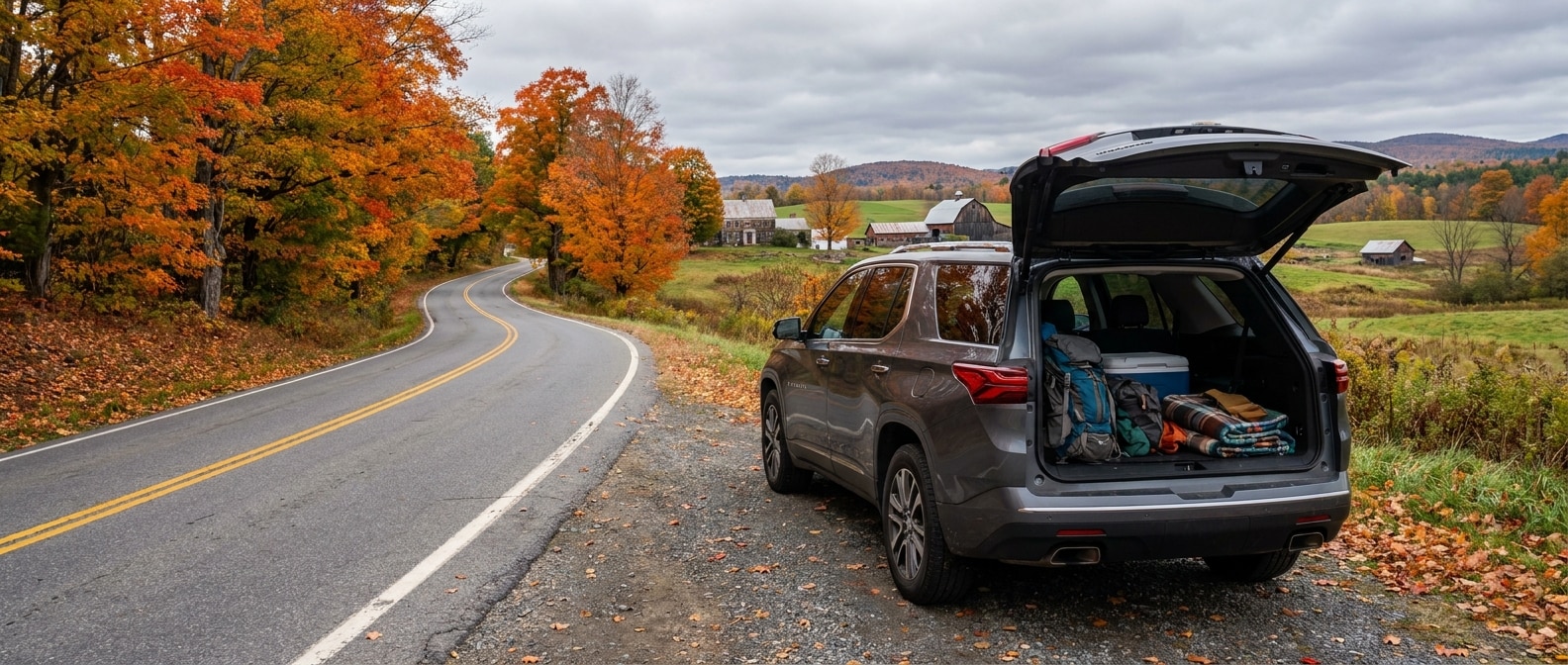
Foliage season in Windham County brings more than color. It brings leaf-slicked two-lanes, slow-moving traffic on VT Route 30, and overnight lows that drop fast enough to trip your tire pressure warning before you've had your coffee. The next few weeks drive nothing like July. Run through this list before you load up, and you'll cover both the fall trip ahead and the first half of your winter prep in a single pass.
Heading out in a Traverse or another Chevy this October? Our service team watches for a handful of things this time of year.
What Goes on the Checklist?
Work through these ten items before any trip longer than a day, and you'll catch the things that actually strand a car in the hills, from soft tires to a tired battery. We've ordered them from highest-consequence to quickest fix, so start at the top if you're short on time.
- [ ] Tire pressure (cold check, all four plus spare) - Check it before the car moves for the day. The correct PSI is on the sticker inside your driver's door jamb, not on the sidewall.
- [ ] Tire tread depth - Try the penny test. If Lincoln's head stays fully visible, the tread is at or below 2/32 inch, so replace before the trip.
- [ ] Tire sidewalls - Look for cracking, bubbling, or cuts, particularly on tires that are five or more years old.
- [ ] Battery load test - Age and cold-start performance matter more than voltage alone. If the battery is three-plus years old, put it on a tester rather than eyeballing it.
- [ ] Engine oil level and condition - If you're within roughly 1,500 miles of your next interval, swap it now. Highway miles are harder on oil than stop-and-go.
- [ ] Coolant, brake fluid, and windshield washer fluid - Top off. Washer fluid is the one that always runs dry on a foliage drive.
- [ ] Wiper blades - Wet leaves, morning frost, and rain all hit at once this season. If the blades streak or chatter, swap them before the trip.
- [ ] Brake inspection - Squealing or grinding under normal braking is your cue to book a service appointment before you leave.
- [ ] All exterior lights - Headlights, taillights, brake lights. Have someone walk around while you work the controls.
- [ ] Emergency kit contents - Jumper cables or a jump starter, flashlight, first-aid kit, a reflective triangle, phone charger, and a jug of washer fluid. A spare rain layer and a small bag of road sand round it out for Vermont fall.
Why These Items Matter in Southern Vermont (and One Honest Tradeoff)
Tire pressure tops this list because the physics works against you every fall, and the fix takes two minutes. For every 10 degrees Fahrenheit the temperature drops, tire pressure falls by about 1 PSI. The U.S. Tire Manufacturers Association cites that rule, and Tire Rack's engineering data lines up with it. Southern Vermont's early fall swings hard. Set a tire to 35 PSI on a 70-degree afternoon, and it'll read close to 31 PSI on a 30-degree morning. The reading is just autumn behavior. It climbs back as the day warms.
Check the pressure cold, before the car has rolled a mile, every single time ahead of a long drive. Your Chevy's TPMS will light up when pressure drops roughly 25 percent below spec, but you'll feel the handling and fuel economy effects well before that light ever glows.
The 2026 Chevrolet Equinox and the 2026 Chevrolet Traverse both include Chevy Safety Assist as standard equipment on every trim. The package covers Enhanced Automatic Emergency Braking, Front Pedestrian and Bicyclist Braking, Enhanced Lane Keep Assist with Lane Departure Warning, Following Distance Indicator, Forward Collision Alert, and IntelliBeam automatic high beams. On a foliage drive up Route 30 toward Newfane, with slower traffic, tight corners, and afternoon sun cutting low through the canopy (a Route 30 classic), you're glad that suite is standard.
None of that changes the physics of wet leaves, though. Maple leaves in early October hold moisture and can cut tire grip on pavement, especially on shaded corners. AWD distributes power. It doesn't add friction between a leaf-covered road and your tire. A lane-keep system that nudges you back into your lane still needs grip to do it. Slower speed and more following distance are what close that gap. The tech helps, but it won't drive for you.
Schedule a pre-trip service visit before the busy foliage weekends, while there's still room on the calendar. Our team can run a battery load test and a tire pressure check in the same visit as an oil change.
Tip: Windshield washer fluid is the one that empties fast on a fall drive. Diluted summer fluid freezes in the nozzle once overnight temps dip below about 28 degrees. Run a winter-rated fluid, one rated to at least minus 20 degrees, now, before the first frost catches you on an open road. You don't want to discover that at a rest stop.
Item / Why It Matters
| Checklist Item | Why It Matters in Vermont Fall |
|---|---|
| Tire pressure (cold) | Every 10 degree F drop = roughly 1 PSI loss; fall swings of 40+ degrees are common |
| Tread depth | Wet leaves reduce available grip; 2/32 inch is the legal minimum, not the safety target |
| Spare tire pressure | Forgotten until needed; a flat spare on a back road is a long wait |
| Battery load test | Cold mornings reveal a weak battery that summer starts hid completely |
| Oil condition | Highway miles and sustained speeds accelerate wear beyond normal commute patterns |
| Wiper blades | Leaf debris, morning frost, and rain all arrive in the same week here |
| Washer fluid | Summer-diluted fluid freezes below 28 degrees F; switch to winter-rated now |
| Brake inspection | Leaf dust and moisture accelerate pad wear; squeal on a mountain descent is the wrong place to find out |
| Exterior lights | Short days and overcast skies make proper lighting more important starting in October |
| Emergency kit | A rural Vermont two-lane in October is not where you want to be without jumper cables |
Schedule a Pre-Trip Service Check
Print-and-Go Recap
Keep this recap somewhere you'll actually see it, because a checklist only helps when it's in front of you as you load the car. Tape it to the dashboard or snap a photo on your phone. Then you've got all ten items in one pass.
Before the trip:
- Tire pressure, cold (all four plus spare)
- Tread depth and sidewall condition
- Battery load test (especially if 3-plus years old)
- Oil level and change if within 1,500 miles of interval
- Coolant, brake fluid, windshield washer fluid (switch to winter-rated)
- Wiper blade check
- Brake inspection (no squealing or grinding)
- All exterior lights
- Emergency kit (cables, flashlight, first-aid, triangle, charger, sand)
- Confirm Chevy Safety Assist features are calibrated (check your Driver Information Center for any active alerts)
On the road:
- Re-check tire pressure after any overnight stop with a significant temperature drop
- Increase your following distance on shaded, leaf-covered corners
- Let the systems work, and drive for the conditions
Shopping for a Chevy before the season turns? Our pre-owned inventory includes vehicles we've already put through a service inspection. A fall trip is a good reason to get into something reliable before the snow arrives.
Frequently Asked Questions
Does AWD prevent sliding on wet leaves?
AWD distributes engine power to all four wheels, which helps you get moving on a slippery surface. It won't change how much friction is available between your tires and a wet, leaf-covered road, and it does nothing for braking. On shaded, leaf-covered corners, easing off the speed and stretching your following distance are the moves that help most. AWD, traction control, and Chevy Safety Assist back up good driving judgment, not replace it.
When should I check tire pressure in the fall?
Check tire pressure cold, meaning before you've driven more than a mile, and let the car sit at least three hours after any driving first. A 10-degree Fahrenheit drop in temperature causes approximately 1 PSI of pressure loss, according to data from the U.S. Tire Manufacturers Association and Tire Rack. Fall morning-to-afternoon swings in southern Vermont can run 30 to 40 degrees, so a tire that read fine on a warm afternoon can sit noticeably low the next morning. Check at least monthly during the season, and always before a long trip.