
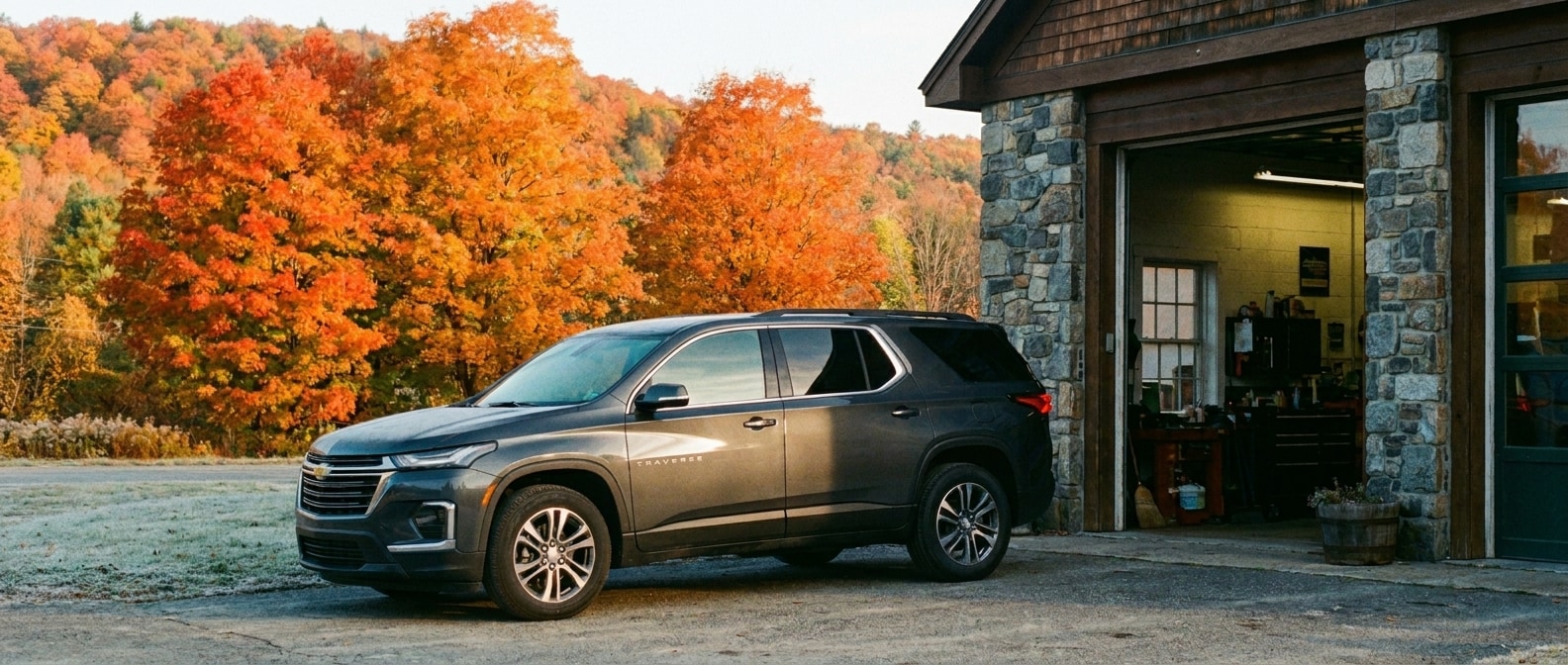
Through the West River valley, October on Route 30 is beautiful and demanding in equal measure. You'll hit slow two-lane traffic, abrupt pulloffs, and late-afternoon sun cutting straight into your eyes on a sharp bend. The brakes on your Chevrolet Traverse or Equinox that quietly got you through last winter's salted roads may be carrying problems you can't feel yet. September is the right moment to find out.
If your vehicle has been through a full Vermont winter without a brake inspection, get one before foliage season opens. Salt and temperature cycles from the past season stress caliper guide pins and brake lines in ways that don't announce themselves with a squeal. Cold mornings ahead will lower your brake fluid's effective boiling point. Both are fixable now.
Book a brake inspection with our service team
What We Check: A Southern Vermont Do and Don't Table
A thorough fall inspection covers all four corners plus the fluid and the lines, and it's where Vermont-specific wear shows up differently from anything a southern-state vehicle ever sees.
| What we do | What we never skip |
|---|---|
| Measure pad thickness at all four corners | Pads below roughly 3mm go on the replacement list; waiting another season on salted roads is not a safe call |
| Check rotor surface for scoring and edge lip | A visible lip at the rotor edge means material has worn away; we measure against the published minimum discard spec |
| Inspect caliper guide pins for corrosion and free movement | Vermont freeze-thaw cycles can lock a pin that slid freely last spring; a seized pin means uneven pad contact |
| Check brake fluid color and clarity | Clear to light amber is healthy; dark or milky fluid signals moisture contamination |
| Inspect brake lines and hoses for corrosion | Undercarriage salt exposure in Windham County is real; lines that look fine in July can show pitting by fall |
| Test parking brake engagement and release | Cold mornings tighten everything; we want confirmation it releases cleanly before first frost |
| What a good inspection does not do | Why |
|---|---|
| Call a soft pedal "normal" | Pedal sponginess often points to air in the lines or degraded fluid; it's a diagnostic finding, not a quirk |
| Skip rear brakes because "they're fine" | Rear pads wear slowly, but rear rotors take the most road spray and salt |
| Rely on a visual check alone for rotors | A rotor can look acceptable and still measure below minimum safe thickness; we use a micrometer, not just a glance |
The Two Failure Modes Vermont Winters Create
Two brake problems come straight out of a Vermont winter, and neither one will show up in a generic checklist written for milder climates. Both trace to salt and freeze-thaw cycles instead of mileage, so a vehicle that spent the cold months parked outside in Windham County can carry them without the odometer hinting at a thing.
Brake fluid and the moisture problem. Brake fluid is hygroscopic, which is the precise term for the way it pulls moisture out of the air over time. Per NHTSA under FMVSS No. 116, fresh DOT 3 fluid must not boil below 401 degrees Fahrenheit. Once that same fluid absorbs roughly 3.7 percent water by weight, the wet boiling point floor drops to 284 degrees Fahrenheit. A foliage drive with sustained slow braking on a loaded vehicle generates real brake heat, and vapor forms in degraded fluid under that kind of load. Vapor compresses. Fluid doesn't. So a pedal can go soft mid-descent on the way back into Brattleboro from a run north toward Newfane. Most manufacturers recommend flushing glycol-based brake fluid every two years regardless of mileage, because moisture builds up whether you drive the vehicle hard or barely at all.
Caliper guide pin seizure. The caliper guide pins let the caliper slide freely so brake pressure reaches both pads evenly. In a salty, freeze-thaw environment, moisture works its way into the rubber boots that protect those pins. One hard Vermont winter can corrode a pin that moved easily the previous fall. A seized pin applies uneven pressure, and you'll see it as a pull under braking or one outer pad worn a lot faster than the inner.
Chevy Equinox drivers and Silverado 1500 owners often run a loaded bed or tow a small trailer. That extra weight makes more brake heat, and it brings both of these issues to a head sooner than on a lightly loaded vehicle.
On AWD and driver-assistance features: StabiliTrak, AWD, and automatic emergency braking are genuine aids, and they work with your brakes, not instead of them. No driver-assistance system compensates for worn pads or degraded fluid. On wet fall roads, reduce speed and extend following distance no matter how your vehicle's equipped.
Schedule a Brake Inspection Before Foliage Season
One Recap Before the Season Starts
Booking one inspection now covers both the foliage rush and the first snow in a single service appointment, and it sends you into Vermont's most traffic-heavy driving month with a clear answer on where your system stands. Foliage traffic on Route 30 picks up in early October. Snow in Windham County follows within weeks.
By the Brattleboro Auto Mall Chevy Team | September 2026
Categories:
People