

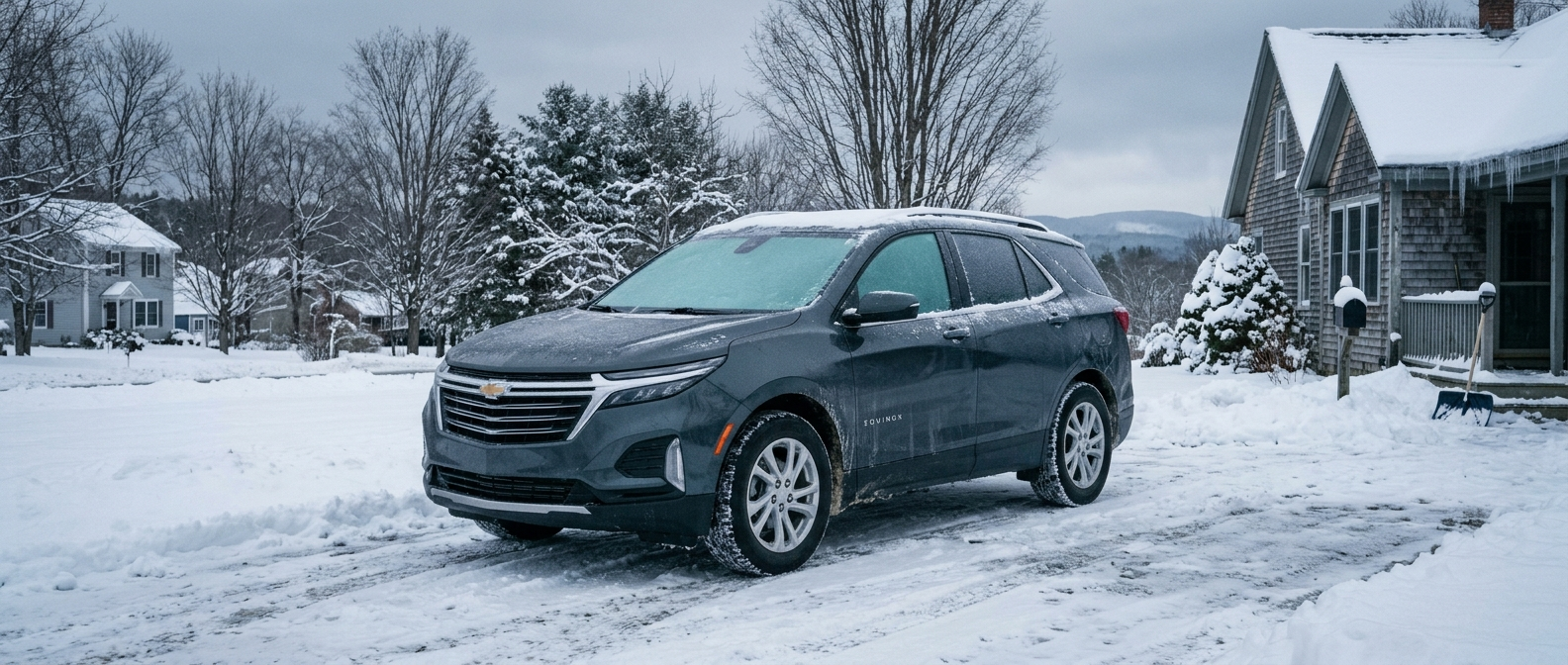
When temperatures in Brattleboro drop toward zero (and they will, every winter), a battery that tested okay in October can leave you cranking a cold engine with nothing to show for it. The short version is that most modern Chevrolet vehicles need an AGM battery rather than a conventional flooded one, and the group size and cold cranking amp (CCA) rating have to match your specific model. Get both right and your Chevy starts reliably through mud season. Get either one wrong and you're calling for a jump on a January morning on Putney Road.
A Chevrolet Equinox makes a good example. The 2026 model calls for a Group 48 (H6) AGM battery rated at 760 CCA. That spec isn't a suggestion. The Equinox's charging system is calibrated for AGM chemistry, running higher maintenance voltage cycles that a standard flooded battery simply isn't designed to handle.
Which Chevrolet Battery Does Your Specific Model Actually Need?
Your model almost certainly needs an AGM battery rather than a flooded one, though the exact group size and CCA rating shift by engine and trim, so the right move is to match the chemistry first and then confirm the numbers for your specific build. The confusion our service team sees comes from drivers buying the cheapest compatible-looking battery on a shelf instead of the type the vehicle actually requires.
Modern Chevrolet models with start-stop systems, advanced infotainment, and multiple driver-assistance modules draw constant low-level power. AGM (Absorbed Glass Mat) batteries hold up under those repeated shallow discharge-and-recharge cycles. A flooded lead-acid battery may fit in the tray and start the engine a few times, but it can fail prematurely because the charging system runs at voltages optimized for AGM chemistry. An AGM battery costs more than a flooded one, and there's no getting around that.
The lineup breaks down like this. Match your model to the row below before you buy anything.
| Model | Battery Group Size | Minimum CCA | Required Type |
|---|---|---|---|
| Equinox (2026) | Group 48 (H6) | 760 | AGM |
| Traverse (2026) | Group 48 (H6) or 94R (H7) | 760-850 | AGM |
| Silverado 1500 (2019-present) | Group 78 | 750+ | AGM recommended |
| Trailblazer | Confirm via owner's manual | Varies by trim | AGM |
| Tahoe / Suburban | Confirm via owner's manual | Varies by trim | AGM |
| Colorado | Confirm via owner's manual | Varies by trim | AGM |
A few notes on the table matter here. First, always verify your specific trim's requirement in the owner's manual or with a Chevrolet-trained technician before you buy. Group size varies by engine and trim level, even within the same model year. Second, the ACDelco Gold BCI Group 78 AGM battery lists a cold cranking amperage of 850A, which is the spec we'd point a Silverado 1500 owner toward for Vermont winters. Third, confirm via owner's manual on that table isn't a cop-out. That line is genuinely the right answer when trim-level variation is real.
How Does a Vermont Winter Actually Affect Your Battery's Performance?
A Vermont winter works against your battery from two directions at once, cutting the chemical output it can deliver at the exact moment your cold engine demands more cranking power to turn over, so even a healthy-looking battery can come up short. At 32 degrees Fahrenheit, a battery can lose roughly 20% of its starting power. At 0 degrees Fahrenheit, that loss can approach 40 to 50%. Southern Vermont hits 0 degrees Fahrenheit reliably every winter, and sub-zero mornings aren't rare. Meanwhile, cold thickens your engine oil, which means the starter motor has to work harder against greater resistance. So your battery is producing less power while being asked to do more work. The result is a double-bind.
A Chevrolet Traverse loaded with hockey gear, a third row of kids, and a heated rear seat is drawing power from the moment you unlock it. Those electrical loads stack on top of the cold-start demand. An AGM battery's advantage here is reserve capacity. It can deliver sustained power under load without the voltage drop that trips up an older or wrong-type battery.
Age matters just as much in our climate. Most batteries last three to five years. In colder climates, the lifespan tends toward the shorter end of that range. A battery that's four or more years old has already lost capacity to normal aging. Add a Vermont January, and that reduced capacity gets exposed fast.
Silverado 1500 owners carry an extra consideration. If you're running a plow setup, auxiliary lighting, or a work upfit, your electrical draw is meaningfully higher than a stock truck, which builds the case for speccing up to the full 850-CCA AGM option rather than the minimum-rated replacement.
For Vermont drivers, both the battery chemistry (AGM, not flooded) and the cold cranking amp rating matter. Matching both to your Chevrolet model is the one decision that separates a reliable winter start from a preventable no-start.
Signs Your Chevrolet Battery Is About to Fail Before Winter
Watch for the following signs, and act on any one of them before November.
- Slow, sluggish cranking on cold mornings (the engine turns over but takes longer than usual)
- Headlights or interior lights noticeably dimmer than normal, especially at startup
- A battery warning light or charging system alert on the instrument cluster
- Visible corrosion (white or blue-green buildup) around the battery terminals
- A resting voltage below 12.4V when tested with a multimeter (a healthy battery reads around 12.6V)
When Is the Right Time to Schedule a Battery Inspection in Vermont?
Right now is the honest answer, with October as the practical window, because the work gets harder to do well once the ground is frozen and you're diagnosing a no-start out in the cold instead of catching a weak battery on a mild fall afternoon. Nail it early and you skip the worst of it.
Check the battery under load, not just at rest. A load test, which measures how the battery performs under actual starting conditions rather than its resting voltage, gives you a real picture of whether it'll hold up. Resting voltage alone can lie. A battery can read 12.5V at rest and still fail a load test because the internal plates have degraded.
If a new battery comes up in the conversation, make sure the replacement is coded to your vehicle's battery management system. Modern Chevrolet vehicles track battery aging and adjust the charging algorithm to suit. Installing a new battery without resetting the battery management system can cause the alternator to keep using the old charging profile, which shortens the new battery's life. Our service team takes that step as part of every battery replacement, and it's one of the details that separates a proper service from a parking-lot swap.
Schedule a service appointment before the first hard freeze, and bring any warning signs you've noticed. Slow cranking last week is useful information. Tell us.
Have Your Battery Tested Before Winter
Frequently Asked Questions
Can I put a regular flooded battery in my Chevrolet Equinox to save money?
We don't recommend it. The 2026 Equinox is designed around an AGM charging system that runs higher maintenance voltages than a conventional flooded battery is built for. That mismatch can cause a flooded battery to fail significantly sooner than its rated life, often within a single season in a cold climate.
How do I know if my Chevrolet has a battery management system that needs to be reset?
Most Chevrolet models from roughly 2012 onward use a battery management module that needs resetting when a new battery is installed. The simplest check is quick. If your Chevy has stop-start technology, an energy management indicator, or a fuel economy display, it almost certainly requires a reset. A Chevrolet-trained technician can confirm and perform the reset as part of the replacement.
My Chevrolet battery seems fine now. Do I really need to check it in October?
Vermont's temperature swings from October into January are large enough that a battery with reduced capacity may still start the engine on a mild fall morning but fail on a 5-degree January morning. Load testing in October gives you an accurate picture of real-world cold-start capacity before the temperatures that actually stress it arrive.