
Drive a Chevrolet 4WD truck or SUV in southern Vermont and you almost certainly qualify as a "severe service" driver under Chevrolet's own maintenance definition. That matters, because severe service cuts several key drivetrain intervals, and the classification is easy to miss.
There's a clear seasonal sequence to follow, though. Hit these items in October and early November, before the salt trucks start rolling, and you'll head into winter with a 4WD system that's ready for whatever Windham County throws at it.
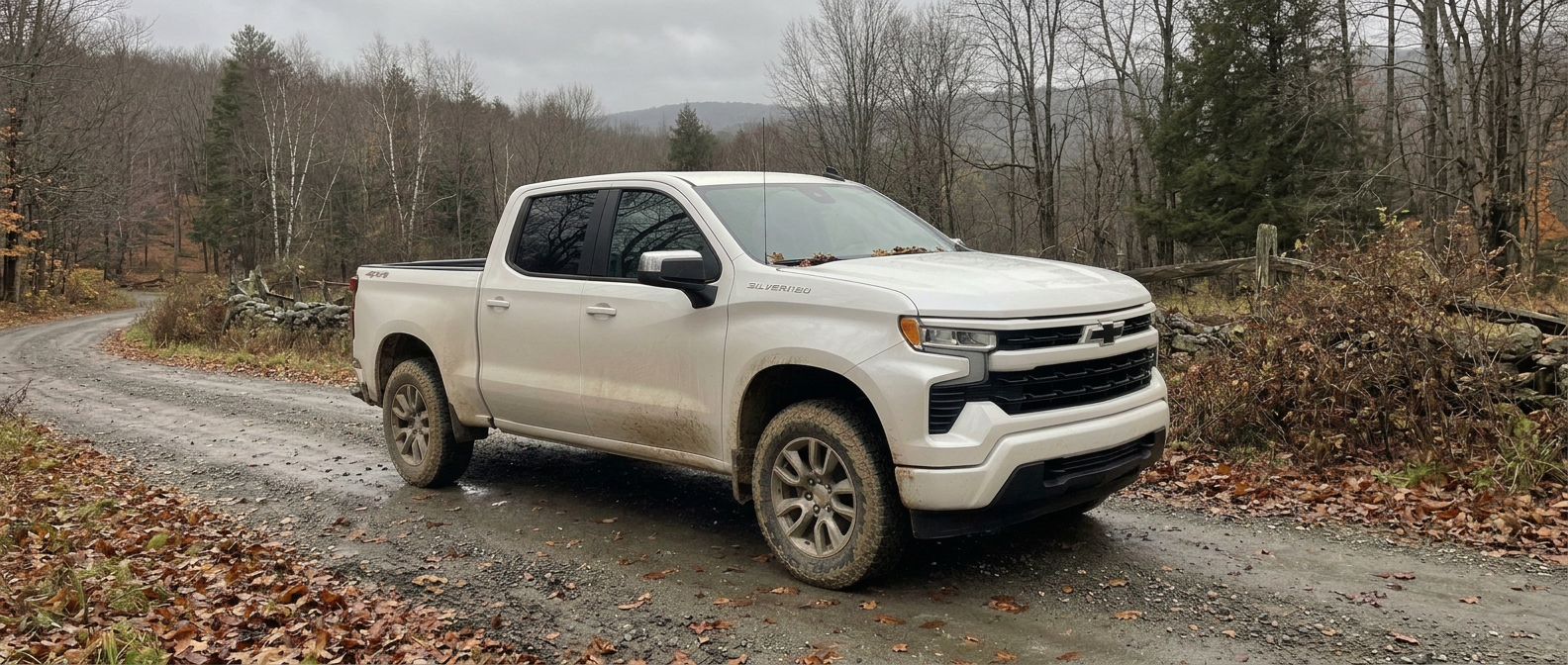
Check our current Silverado 1500 inventory if you're shopping for a truck that can handle the full Vermont year.
When Does Vermont Driving Qualify as "Severe Service"?
If your Chevy runs southern Vermont roads year-round, it almost certainly qualifies as severe service, and the trigger is an everyday stack of conditions that build on each other. Chevrolet's own definition covers repeated short trips in sub-freezing temperatures, dusty or unpaved roads, and extended operation in extreme cold. Look at what that means for a Brattleboro-area driver.
Vermont Agency of Transportation 2026 data shows Windham County has 853 miles of dirt roads against 638 miles of paved surface. More dirt than pavement.
Statewide, Vermont has 8,517 miles of dirt roads compared to 7,239 miles of paved highway, per VTrans. If your commute or school run touches any of those miles between late March and early May during mud season, your drivetrain is working in dusty, wet, and soft-road conditions by definition.
Then add the salt. VTrans operates under a "safe-roads-at-safe-speeds" policy rather than a bare-roads policy, which means Vermont roads carry active snow cover during storms. Salt is applied aggressively, and it stays on the surface long after the weather clears. Salt like that works into every crevice underneath a truck or SUV.
And finally, consider the thermometer. Sub-freezing cold-starts, a short drive to Brattleboro Union High School or Brattleboro Memorial Hospital, idle time while the cab warms up. Those repeated cold short-trips are exactly what the severe-service category is built for.
Our team's observation: On trucks that live on Windham County dirt roads, the undercarriage shows accelerated corrosion on frame-mounted components when they come in for service. Which is exactly where the 4WD system's ground connections sit. A corroded ground point is one of the documented causes of a "Service 4WD" warning light, even when the mechanical components themselves are fine.
The Seasonal Service Table: What to Book and When
The severe-service classification stops being abstract right here, because every interval below shifts once Vermont conditions apply. Here are the key 4WD-specific items, the normal interval, and what severe-service driving does to each schedule.
| Service Item | Normal Interval | Severe-Service Interval | Vermont Trigger |
|---|---|---|---|
| Transfer case fluid (Silverado 1500 4WD) | 100,000 mi | ~45,000 mi | Dirt roads, cold short-trips, sub-freezing starts |
| Transfer case fluid (Silverado 2500 HD/3500 HD) | 50,000 mi | ~25,000 mi | Same, plus towing/plowing |
| Automatic transmission fluid | 90,000 mi | 45,000 mi | Towing, mountain grades, extended cold idling |
| Front/rear differential fluid | Check at 45K; replace by 60K for towing use | Earlier if towing or off-road frequent | Dirt roads, mud season, regular towing |
| Brake fluid | Every 3 years | Every 2 years for severe/towing use | Salt moisture absorption accelerates degradation |
| Engine oil (via Oil Life Monitor) | Up to 7,500 mi | May alert as early as 5,000 mi | Cold-start short trips trigger earlier alerts |
The transfer case number is the one worth a second look. On a Silverado 1500 under normal service, Chevrolet lists 100,000 miles as the transfer case fluid interval. If you bought your truck a few years ago and put genuine Vermont miles on it, severe service cuts that interval to roughly 45,000 miles and it may already be due. That's nearly half.
AWD, 4WD, traction control, and stability control are driver aids. They improve traction capability meaningfully, but they work within the limits of physics. Reduce speed and increase following distance in winter conditions regardless of drivetrain.
The Tahoe runs a 5.3L or 6.2L EcoTec3 V8 with 4WD across its trim lineup (LS through Z71), and its transfer case follows the same severe-service logic as the truck platform. Same discipline applies.
The Traverse uses AWD rather than a traditional 4WD transfer case. It doesn't have a transfer case fluid service in the same way, but the front/rear differential and AWD clutch pack do need periodic attention under severe service, and Vermont short-trip cold weather qualifies there too.
Don't power-wash the transfer case. High-pressure water aimed at the transfer case or front and rear axle output seals can force past those seals and contaminate the fluid. Chevrolet's service documentation calls this out directly. If you're cleaning the undercarriage, use a garden hose, not a pressure washer pointed at the drivetrain.
The "Service 4WD" light isn't always a mechanical failure. As noted above, a corroded ground connection on the 4WD control module can trigger that warning, and it's common on trucks with significant salt exposure. Check the ground points before you assume a more expensive fix.
Print-and-Go Pre-Winter Checklist
Run through this list before the first serious storm hits, and you'll catch the small problems while they're still small and flag the drivetrain items that need a lift. Some of these you can eyeball in your own driveway, and the rest are service-bay work.
- [ ] Check transfer case fluid level and condition (discolored or burnt fluid = replace now, not at the next mileage marker)
- [ ] Confirm transfer case fluid service mileage against your severe-service interval, not the normal one
- [ ] Inspect front and rear differential fluid, especially if you've done any towing or spent time on soft dirt roads
- [ ] Have brake fluid tested for moisture content (it absorbs water over time; Vermont's salt environment accelerates that)
- [ ] Inspect brake pads and rotors. Mountain grades and rutted dirt roads accelerate pad wear
- [ ] Verify the Oil Life Monitor reading and confirm your last oil change was with a dexos-approved full-synthetic
- [ ] Inspect undercarriage ground connections for corrosion (particularly the driver's-side frame rail area on trucks)
- [ ] Confirm 4WD engagement: test Hi and Lo range in a safe open area before you need them on a slick hill
- [ ] Check tire tread depth. Worn tires undermine everything the 4WD system does
- [ ] Inspect wiper blades and top up washer fluid with a freeze-rated formula
The last checklist item sounds minor. It isn't.
A streaked windshield on a bright-sun Vermont winter morning, with road spray coming off a sanding truck on I-91, is a real visibility problem.
Book a service appointment and mention the severe-service checklist. Our team will run through the drivetrain fluid inspection as part of the visit.
One Honest Trade-Off
For a Windham County driver, 4WD earns every bit of its maintenance overhead. It's not negotiable if your commute includes a dirt-road stretch, if you're on call at Brattleboro Memorial Hospital on a storm night, or if you're hauling a family's worth of ski gear. The tradeoff is real. A properly maintained 4WD system asks for more attention than a 2WD vehicle, with more fluids to monitor, more components to inspect, and more intervals to track. Skip that overhead and you'll eventually skip a gear engagement when you need it most, or you'll spend more at the shop than the scheduled fluid changes would have cost.
It works best when you treat it like the Vermont tool it is, not a set-and-forget box you checked at the dealership. The system works.