
Vermont roads don't treat your wheels the way flat highway miles do. The freeze-thaw cycle that heaves our pavement every winter does more than make the drive uncomfortable. It reshapes the geometry under your tires. Whether you actually need an alignment comes down to which of three situations you're in. We've laid them out below so you can match your situation to the right response.
The short version
- After a hard pothole or frost heave hit: Get an alignment check promptly if you notice pulling, a crooked steering wheel, or new vibration.
- Annual fall pre-winter check: The single highest-value alignment moment in Vermont. Catches drift that built up over a full season of bad roads before winter makes it worse.
- Post-mud season (April/May): If you live on or commute a class-4 or dirt road, add a spring check; pavement drivers can often wait for the annual.
- Alignment vs. balance: Shake at highway speed is almost always a balance issue, not alignment. Pulling and uneven edge wear point to alignment.
- Tire consequence: Bad alignment, especially toe error. Can burn through a set of tires in 10,000 to 15,000 miles instead of the normal 40,000 to 70,000.
How Do Vermont Roads Actually Knock Wheels Out of Alignment?
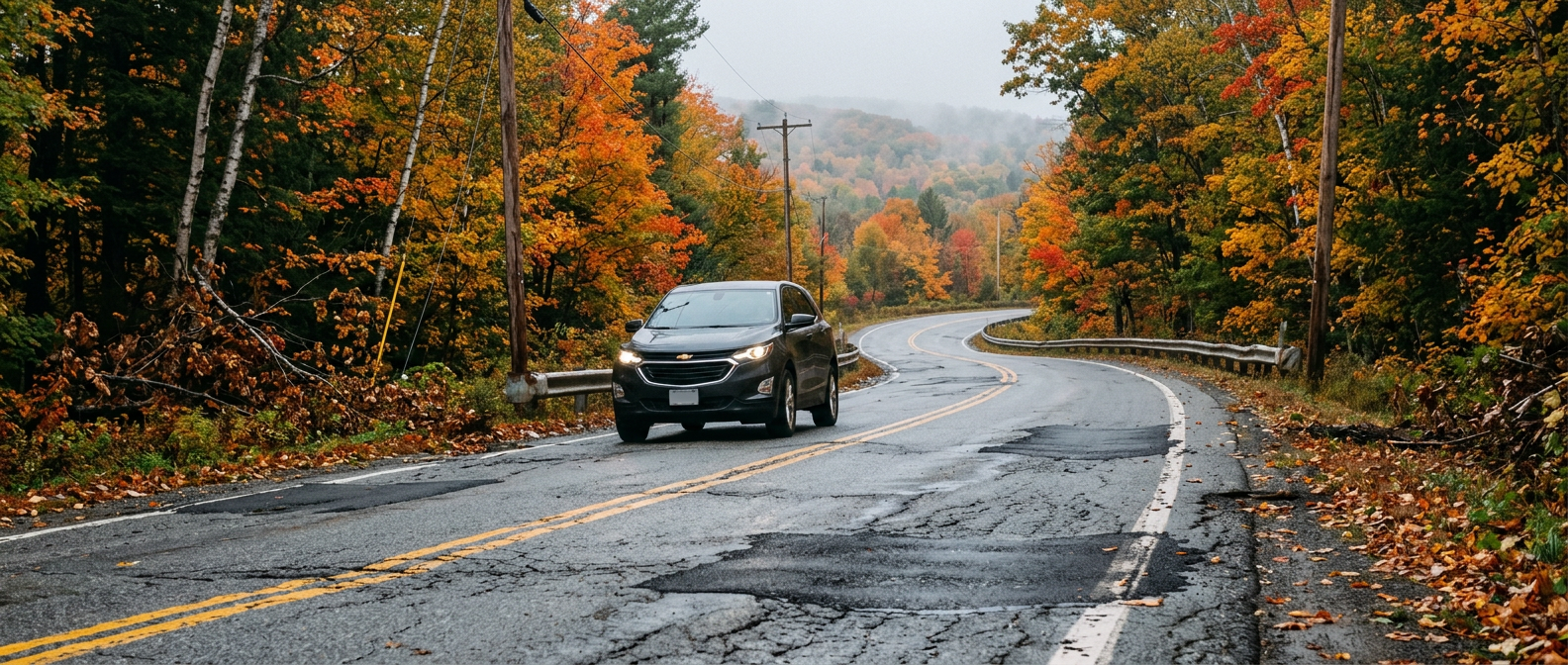
Vermont roads knock wheels out of line through the ice lens under the asphalt, where water seeps into cracks beneath the pavement, freezes and expands, lifts the surface into an uneven ridge, then drops it back when the melt comes, sometimes leaving a void that collapses into a pothole. You hit that ridge or that hole at commuting speed, and the suspension takes two impacts, one going in and one coming out. The second hit often carries more force because the suspension is already compressed from the first.
Those repeated impacts work against the three angles that keep your wheels pointed right. Toe is the angle your tires point inward or outward seen from above, and it's the fastest tire-killer when it drifts. Camber is the inward or outward tilt of the wheel seen from the front, and too much in either direction loads one edge of the tire harder than the other. Caster is the steering axis tilt that gives the wheel its self-centering feel and highway stability.
Vermont's roads aren't getting any easier on suspensions. Spring 2026 brought some of the worst frost heave conditions the Upper Valley has seen in memory, and public works crews in multiple towns reported paved roads rougher than prior years. A Vermont Senate Transportation Committee comment in 2026 named suspension and steering damage from potholes and frost heaves as an ongoing consequence for drivers here.
Take Route 30 through the West River valley toward Newfane. A winding two-lane with low shoulders, drainage challenges, and sections that freeze and thaw at different rates depending on sun exposure and soil type. One pothole-heavy mile on a road like that, taken at normal speed, can be enough.
How Do the Three Vermont Alignment Scenarios Compare?
The comparison that matters comes down to which of three situations you're in, since Vermont roads knocking wheels out of line is a given, and each situation carries its own urgency and its own thing the check will turn up. So match yourself to one of the three rows below before you book anything.
| Scenario | What triggered it | Key symptoms to watch | Urgency | What the check catches |
|---|---|---|---|---|
| Post-impact (pothole or frost heave hit) | One hard or repeated sharp impact | Pulling to one side, steering wheel no longer centered, new vibration | High. Check within days | Acute toe, camber, or caster shift from that impact |
| Annual fall pre-winter | A full season of bad roads, no single event | Gradual drift, mild uneven edge wear, slightly off-center wheel | Medium, before first snow | Cumulative drift across all angles; finds what a season of heaves added up to |
| Post-mud season | Dirt and class-4 road ruts, soft sub-base | Similar gradual drift, more pronounced if commute involves unpaved roads | Medium. Late April or May | Rear-axle drift on AWD and 4WD vehicles; checks what mud season's ruts did |
The post-impact scenario is the easy one to put off, and the one where putting it off costs the most. Tire wear from toe error builds with every mile. Pirell's technical guidance notes that even a minor misalignment can remove thousands of miles from a tire's useful life, and a significant toe error can chew through tread depth in just a few hundred miles.
How Can You Tell If It's Alignment, or Something Else?
Telling alignment apart from the faults it mimics is where you save real time and money, because not every pull and not every shake traces back to the angles, and reading the symptom right keeps you from paying for a fix your car doesn't need.
Shake at highway speed is almost never an alignment problem on its own. The usual culprit is balance, a wheel weight that shifted or a tire that developed a flat spot over a cold winter. Alignment faults rarely cause vibration by themselves. If your wheel vibrates above 50 mph but the car tracks straight, start with a balance check rather than an alignment.
Pulling that follows the car, not the road is alignment territory. Try a quick self-check. Inflate all four tires to the door-jamb placard pressure and drive the same stretch in both directions. If the pull follows the car regardless of direction, the angles need a proper measurement.
Uneven edge wear, with one shoulder of the tread worn noticeably smoother than the rest, is camber telling you something. Run your hand across each front tire, and if the inside edge feels sharper (more worn) than the outside, camber is pulling load onto that edge.
A steering wheel that sits crooked while the car goes straight points to a toe or thrust-angle issue. The car's tracking at a slight diagonal, and you hold the wheel over to compensate without noticing.
For families running an Equinox or a larger Traverse through southern Vermont's mix of paved town roads and dirt driveways, our service team checks all four wheels, not just the front. Modern independent rear suspensions can drift on rear angles too, especially after a season of uneven surfaces, and a front-only alignment on those vehicles leaves half the job undone.
Toe misalignment is the biggest tire-killer: a vehicle with badly misaligned toe can burn through a set of tires in 10,000 to 15,000 miles instead of the normal 40,000 to 70,000.
Pros and Cons: Getting Alignment Checked at Each Vermont Interval
| Alignment Timing | Pros | Cons |
|---|---|---|
| Post-impact (right after the hit) | Catches acute damage before tire wear sets in; identifies bent components early | Requires an extra trip if no other service is due |
| Annual pre-winter check | Single highest-leverage moment; corrects a full season of drift before snow makes handling critical; often combinable with tire changeover | Easy to postpone; a busy fall service calendar means booking ahead matters |
| Post-mud season (spring) | Essential for dirt-road commuters; catches rear-axle drift on AWD; pairs naturally with seasonal tire swap | Lower urgency for pavement-only drivers; can feel like a lot of service in a short window |
Which Vermont Scenario Fits Your Situation?
Which scenario fits comes down to what just happened to the car and how you drive it, and the clearest case is a hard impact, so if you hit something and the car's now pulling or the wheel sits crooked, go sooner because the tire wears with every mile.
If you haven't had an alignment check in over a year and you're a southern Vermont driver, the fall window before first snow is the right moment. You've just put a full season of frost heaves, spring potholes, and mud-season ruts behind you. Correcting whatever drift accumulated before you're driving on slick roads is just practical maintenance. The same holds whether you're commuting across the river to Keene or doing school runs to Brattleboro Union High School.
If your daily route involves a dirt or class-4 road, and plenty of Windham County routes do, add a spring check to the rotation. The ruts and soft sub-base that mud season leaves under your tires can shift rear suspension angles a winter check wouldn't have caught. AWD systems and 4WD trucks work best when all four wheels track together instead of fighting each other.
What does a full season off alignment actually look like in the bay? Usually it hides until a vehicle comes in for a fall tire changeover, and we pull the tire to find edge wear on the inner shoulder the driver never felt a thing from. The tire lost a meaningful chunk of its remaining life anyway.
Don't put new tires on a misaligned vehicle. You'll ruin the new set just as fast as the old ones. Alignment before new rubber goes on, or at the same time, is how the new tires get the full life they're rated for. Schedule service at Brattleboro Auto Mall Chevy and we'll handle both in one visit.
Frequently Asked Questions
Does hitting a frost heave really knock a car out of alignment?
It can, yes. Vermont's freeze-thaw cycle creates ice lenses that push road surfaces into uneven ridges. Hitting one of those ridges at commuting speed produces two impacts on the suspension, one entering the heave, one exiting, and the exit impact often carries more force because the suspension is already compressed. That force can shift toe, camber, or caster angles without any visible wheel or tire damage. The symptom isn't always immediate pulling. Sometimes it shows up as gradual uneven edge wear over a few thousand miles.
How is an alignment check different from a tire balance?
They fix different problems. Balancing corrects the weight distribution around a wheel and tire assembly, and it's what stops the shimmy or vibration you feel at highway speed. Alignment corrects the angles at which the wheels point and tilt relative to each other and the road. A car can be perfectly balanced and still badly misaligned, so it'll track crooked and eat tires on one edge. If your symptom is shake above 50 mph, start with balance. If it's pulling, a crooked steering wheel, or one-sided tread wear, alignment is the likelier culprit. FAQ: - Q: Does hitting a frost heave really knock a car out of alignment? A: It can. Freeze-thaw cycles create ice lenses that heave pavement, producing two impacts on the suspension when struck at speed; the exit impact often carries more force, shifting toe, camber, or caster angles without visible damage. Symptoms may be immediate pulling or gradual uneven edge wear over a few thousand miles. - Q: How is an alignment check different from a tire balance? A: Balancing corrects weight distribution around the wheel assembly to stop vibration. Alignment corrects wheel angles relative to each other and the road. A perfectly balanced car can still be misaligned and track crooked. Shake above 50 mph suggests balance; pulling, crooked steering, or one-sided wear suggests alignment.