

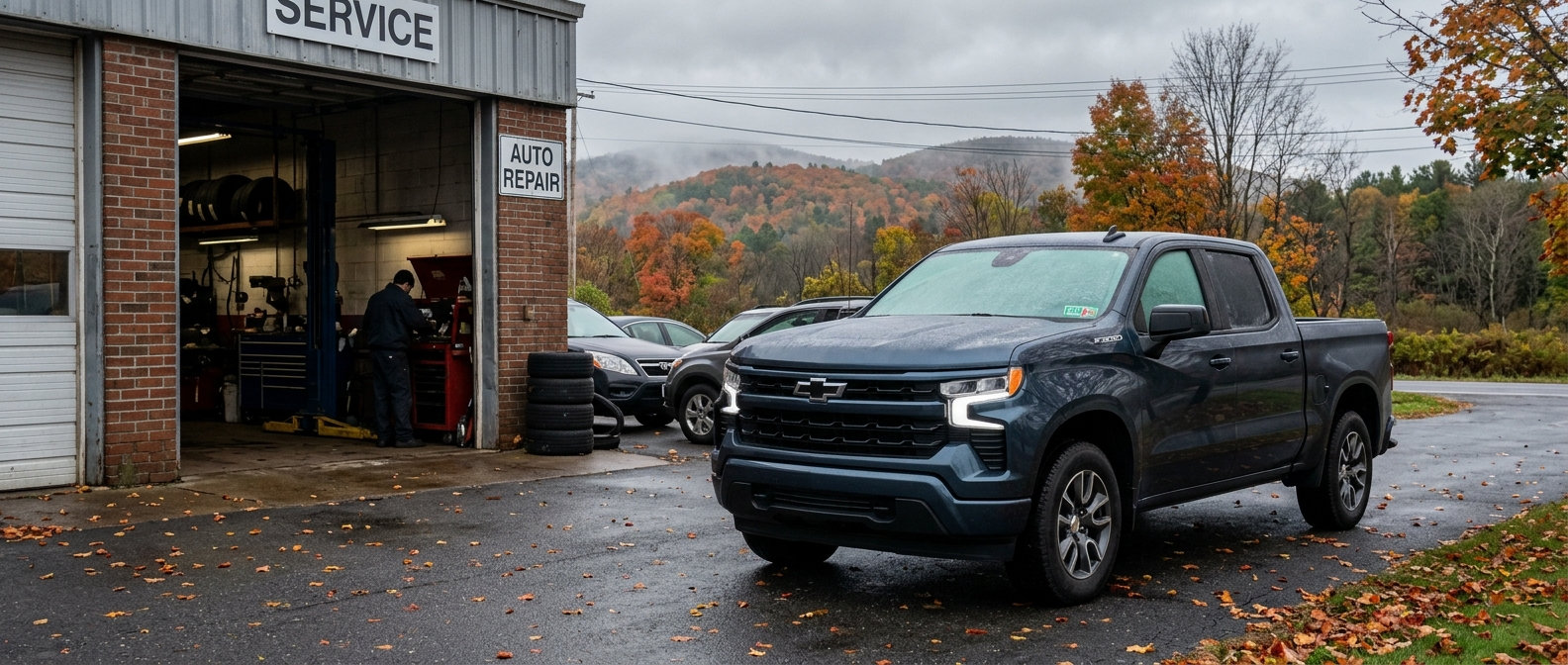
If you're looking at your 2026 Silverado 1500 and wondering whether to trust the orange "Change Engine Oil Soon" light or the 7,500-mile number you read online, you're asking the right question. The answer rides on what kind of driving you do here in southern Vermont, and those two things don't always line up.
The Silverado 1500 is built around GM's Engine Oil Life Monitor, which we'll call the OLM, a system that tracks how hard your engine actually works rather than counting miles the way an old sticker used to. That shift changes how you should read your maintenance schedule, and it matters more in a climate like ours.
The OLM tracks engine stress, not mileage. Cold starts, short trips, and trailer loads all shorten your real interval, even when the odometer has barely moved.
How Does the Oil Life Monitor Actually Work?
The Oil Life Monitor behaves like a judgment the truck makes for itself, reading engine conditions continuously and estimating how much protection the oil has left, so depending on how you drive it can call for service early or let you run well past a fixed sticker. It's easy to picture an oil-change countdown where you drive 7,500 miles and the light comes on. That isn't what happens inside the truck.
Chevrolet's OLM measures engine revolutions, operating temperature, and idle time continuously, then calculates how much protective capacity remains in the oil. A Silverado that spent its last 4,000 miles on the highway at steady cruise sits in a completely different place than one that covered the same miles in short cold-morning runs to Brattleboro Union High School and back. The highway truck might have plenty of life left. The short-trip truck is already working degraded oil.
When the system figures that roughly 10 percent of useful oil life remains, the "Change Engine Oil Soon" message appears. Chevrolet's guidance is to schedule service within the next 600 miles once that shows up. Don't reset the monitor without changing the oil, because the computer's math depends on knowing when a real change happened.
One rule doesn't bend. Even if the monitor never hits zero, Chevrolet requires an oil change at minimum once every 12 months. Moisture builds up in oil that sits, no matter how few miles it's seen.
| Feature | What It Monitors | What It Tells You |
|---|---|---|
| Engine revolutions | How hard the engine is working | Heavy loads and towing burn through oil faster |
| Operating temperature | Warmup time and sustained heat | Cold starts that never fully warm up stress the oil more |
| Idle time | Prolonged idling (remote start, warming up) | Long idles count against oil life without adding miles |
| Time elapsed | Calendar life of the oil | Triggers the 12-month minimum regardless of mileage |
What Counts as Severe Service Here?
Plenty of everyday driving around southern Vermont lands a Silverado in what Chevrolet calls "severe service," and the catch is that it rarely feels severe from the driver's seat, since cold starts and short mud-season hops do the damage quietly while the odometer barely moves. So it's worth knowing the signs.
Silverado 2500 HD owners who haul or plow already know to stay on top of it, but even a 1500 hauling a trailer twice a month, cold-starting in a 10-degree garage, or grinding through Putney Road stop-and-go in mud season is piling on wear fast. Under any of those conditions, the OLM will call for service before 7,500 miles, often in the 5,000-to-6,500-mile range.
Chevrolet's own definition of severe service covers several conditions.
- Frequent towing or hauling near the truck's rated capacity
- Repeated short trips where the engine never fully warms up
- Extended idling (remote start on cold mornings, sitting in traffic)
- Extremely cold temperatures
- Dusty or unpaved road driving
Mud season on a dirt town road in Dummerston or Guilford hits two of those categories on its own. If you're also warming the truck up for five minutes before school pickup (a routine Vermont morning in January), that's three.
Schedule your service interval around what the monitor actually reports, since that reading reflects your real driving far better than an old online number.
Our team's take: The 2.7L TurboMax and the 3.0L Duramax diesel both need the right oil grade, not just any full synthetic. The TurboMax calls for SAE 5W-30 dexos1 full synthetic, while the 5.3L and 6.2L V8 engines run SAE 0W-20 dexos1 Gen 3. Mixing grades between service visits throws off the OLM's reliability. When you bring it in, tell us which engine you've got and we'll confirm the spec.
The Full Service Milestone Map
The oil-and-rotation rhythm is the backbone of this schedule, yet a few larger milestones carry just as much weight, and while they're easy to put off, letting them slide is where a well-kept truck quietly starts aging faster than it should in a climate like ours.
Below, the milestones build on that same oil-and-rotation rhythm. Each one addresses a part that wears on its own clock.
| Milestone | Key Services | Severe-Service Note |
|---|---|---|
| Every 7,500 mi (or when OLM alerts) | Oil and filter change, tire rotation, brake inspection, multi-point inspection | Under severe conditions, OLM may alert at 5,000-6,500 mi |
| 22,500 mi | Everything above, plus cabin air filter replacement | Vermont road dust and pollen make this one worth not skipping |
| 45,000 mi | Engine air filter replacement, evaporative control system inspection, rear-axle fluid if limited-slip differential equipped | Towing trucks: consider transmission fluid at this interval |
| 60,000 mi | Spark plugs on the 2.7L TurboMax, transmission fluid review for towing use, cooling system inspection | The 5.3L and 6.2L V8 spark plugs run to 97,500 miles |
| 97,500 mi | Spark plugs on the 5.3L and 6.2L V8, serpentine belt inspection, full brake inspection | Transfer case fluid if 4WD-equipped |
| Annually (regardless of mileage) | Battery health test, wiper blade inspection, underbody corrosion check, oil change if monitor hasn't triggered yet | Road salt makes the underbody check a real item up here |
The transmission fluid note at 45,000 miles is the one we want to flag directly. If your truck tows, Chevrolet's severe-service guidance moves that fluid earlier than the normal schedule implies. The fluid does real work under trailer load, and keeping it clean protects a 10-speed transmission that has no cheap way to fail.
Schedule Your Silverado Service Appointment
What This Means for Your Next Silverado
Following the maintenance schedule is what lets a Silverado hold together past 200,000 miles in a climate that tests it hard, which is exactly why a well-kept truck is still worth driving a decade from now even after it's earned its keep. So the schedule isn't a penalty for owning a truck. It's an investment in one.
If you're deciding between a Silverado 1500 and a Silverado 3500 HD and long-term upkeep is part of the math, the honest answer is that the 1500 carries a lighter maintenance burden under moderate use, while the HD's more intensive schedule reflects the harder work it does. Maintenance stays manageable on either one when you follow the monitor. It climbs fast when you ignore it.
The 3.0L Duramax diesel deserves its own callout. It adds fuel filter replacement, which the filter life monitor flags for you or roughly every 22,500 miles, and asks you to top off Diesel Exhaust Fluid periodically, usually every 4,000 to 6,000 miles of use. Those are real items, not exotic ones, though they're extra line items next to the gas engines. For drivers racking up highway miles or long-distance towing, the fuel economy still makes the diesel worth it even with that added service.
Our service team can pull your truck's current OLM reading and give you a plain-language picture of where you stand and what's coming up next. No guesswork involved.
Frequently Asked Questions
How often does the 2026 Silverado 1500 actually need an oil change?
The 2026 Silverado 1500 uses GM's Engine Oil Life Monitor rather than a fixed mileage interval. Under normal conditions, oil changes typically fall between 7,500 and 10,000 miles, or at 12 months, whichever comes first. Under severe conditions, such as frequent towing, repeated cold starts, or lots of short trips, the monitor triggers service sooner, often between 5,000 and 6,500 miles. Let the monitor set the timing instead of a mileage sticker.
Does towing change the Silverado maintenance schedule?
Yes, meaningfully. Regular towing places extra heat on the transmission fluid, engine oil, brakes, and differential fluid. The Oil Life Monitor will call for oil changes sooner under towing loads. For transmission fluid, Chevrolet's severe-service guidance recommends a fluid change at 45,000 miles for trucks that tow frequently, earlier than the standard schedule implies. Check your door-pillar sticker for your specific truck's payload and towing ratings, and tell your service advisor how you use the truck so the intervals get set correctly.