

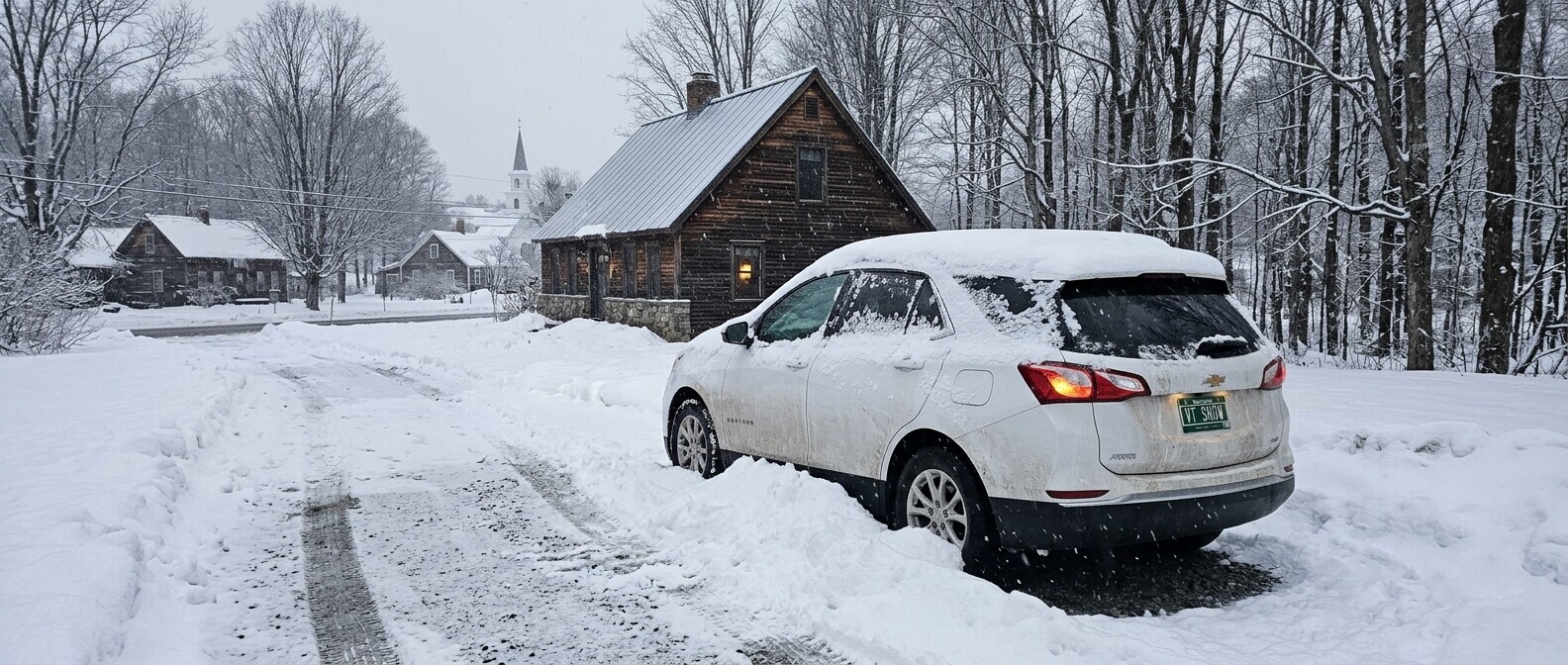
A blizzard watch goes up on a Tuesday afternoon. By Wednesday morning Brattleboro has eight inches on the ground and more coming. You know you'll need to get out. Maybe to stock the Traverse before the second wave hits, maybe to reach Brattleboro Memorial Hospital for something that won't wait for a plow. You're going to drive. The open question is whether your Chevy can do it.
So what does your Chevy actually do out there? That answer comes down to systems you rarely think about until a storm, like what AWD really controls, what Snow/Ice drive mode changes in the calibration, and why a cold battery can undermine all of it before you back out of the driveway. We walk through each one below.
AWD helps your Chevy get moving on snow. It does not reduce stopping distance on ice. Winter tires are the upgrade that improves both.
The 2027 Equinox is a good place to start because it sits right in the middle of the Brattleboro-family segment, compact, with available AWD, real ground clearance, and a Drive Mode Selector that includes a dedicated Snow/Ice setting. Everything here applies across the Chevy lineup, with the differences called out in the table below.
How Does AWD Actually Work on a Chevy?
AWD on the 2027 Equinox is an on-demand system that runs primarily on the front wheels in normal conditions, then senses slip and sends torque to the rear axle the moment a wheel loses grip, say pulling out of an unplowed side street, all without you touching a button. The help is real, and so is the limit.
AWD puts power wherever a wheel can use it. What it can't do is make more friction between tire and road than physics allows. On glare ice, sending equal power to four wheels is still four wheels' worth of near-zero grip. And because AWD adds weight over a FWD-only setup, stopping distance can run a little longer on a heavy vehicle wearing the same tires.
On packed snow and slushy roads, AWD gives you real traction, and that covers most of Windham County in a typical November blizzard. On black ice or heavily compressed snow, the tires decide what happens next, and the drivetrain just rides along.
| System | How it works | What it helps in a blizzard | What it doesn't do | Best Chevy match |
|---|---|---|---|---|
| FWD | Engine drives front wheels only | Fine on plowed roads and light snow | Struggles on steep unplowed grades | Trailblazer, base Equinox LT |
| On-Demand AWD | Runs FWD, shifts torque to rear on slip detection | Confident acceleration on packed snow, slush, driveway exits | Does not shorten stopping distance; no benefit on glare ice | 2027 Equinox AWD, Traverse LT/RS/High Country |
| Advanced Twin-Clutch AWD | Distributes torque side-to-side across rear axle for sharper cornering grip | Superior lateral grip on winding roads, unplowed turns | Still depends on tire compound for braking | Traverse Z71 |
| 4WD (part-time) | Driver selects 4WD High or Low; locks front and rear axles | Strong grip for getting unstuck, steep grades, loose snow | 4WD Low is not for plowed highway driving; no cornering advantage | Silverado 1500, Tahoe, Suburban |
Which Setup Do You Actually Need for Brattleboro Winters?
Which setup you need depends mostly on where you drive in town, since Brattleboro's roads split into two groups the morning after a blizzard, the plowed-and-salted arteries like Putney Road and Route 5 on one side and the slower side streets off Elliott and the town roads toward Guilford on the other. Those back roads and the stretch by Living Memorial Park take longer to clear, and they go soft under the heavy wet snow a southern Vermont nor'easter drops.
If your daily drive keeps you on the main arteries, a well-maintained Trailblazer on fresh winter tires is legitimately capable. If your commute crosses the Connecticut River into Keene, or you live off a dirt road that climbs a grade, the AWD option on the Equinox or the Traverse becomes the difference between leaving on time and staying home.
Brattleboro Memorial Hospital sits a short drive from most of town. In a blizzard, the short drives are the ones that expose an unprepared vehicle fastest. Cold-soaked brakes, a battery that won't turn the engine, worn tread that can't grip the hill on Belmont Avenue, those are the failure modes that show up. Our service team works on all of them. Address them before the forecast changes.
Before the storm:
- Replace any tire with tread below 4/32 of an inch on any corner before winter comes
- Load-test any battery over three years old, since cold cuts the available cranking power, and a battery that starts fine in October can fail at 10 degrees in January
- Switch the washer fluid to a winter-rated mix, because the summer formulation freezes on the glass mid-wipe, right when you need to see
- Check the coolant protection level, since a 50/50 antifreeze-to-water mix holds freeze protection down to roughly minus 34 degrees Fahrenheit
- Fill the tank before the storm, because a low fuel level can let moisture into the fuel system in extended cold, and you'll burn more fuel idling to warm up
What the Drive Mode Selector actually does:
When you select Snow/Ice on a 2027 Equinox, the system softens throttle response to cut wheel spin on initial acceleration. Engine output ramps up more gradually, so the tires hold their grip on a slushy start. Braking behavior stays the same. There's no manual AWD engagement, since that system runs on-demand on its own. Think of it as a lighter touch on the pedal at the moment the tires are most likely to spin.
Cold-morning note: The 2027 Equinox offers an optional engine block heater. In a Vermont January, a block heater earns its keep. It shortens warm-up time, reduces cold-start wear, and gets the cabin heater producing real heat faster. If you park outside without one installed, it's worth asking our team about at service before the cold sets in.
| Term | What it means in plain language |
|---|---|
| On-demand AWD | AWD that activates automatically when slip is detected; you don't turn it on |
| Snow/Ice drive mode | Software adjustment that limits throttle response to reduce wheel spin at startup |
| Cold cranking amps (CCA) | A battery's ability to start the engine in cold temperatures; rated in amps at 0 degrees Fahrenheit |
| Engine block heater | An electric element that pre-warms the engine coolant when plugged in overnight |
What This Means for Your Next Chevrolet
If you're shopping now, blizzard readiness comes down to two decisions, drivetrain and tires, with AWD available on every 2027 Equinox trim (LT, RS, and ACTIV), on the Traverse LT, RS, and High Country, with the Z71 adding the more capable twin-clutch system standard, and on the Silverado 1500 in 4WD configuration. The Traverse also comes with available Terrain Mode and Hill Descent Control on the Z71, worth understanding if you're regularly pulling out of a steep driveway or working through unplowed back roads.
On the tire side, AWD with all-season tires beats FWD with all-seasons in deep snow. AWD with dedicated winter tires beats either by a wide margin. FWD with winter tires outperforms AWD on all-seasons in cold braking tests. Those comparisons are the hierarchy that matters, and we say it plainly because you're better served putting winter tires on a base FWD Equinox than skipping them on an AWD one.
Southern Vermont winters run roughly November through March, with the heaviest blizzard risk in January and February. The right drivetrain and the right tires make a material difference on every trip through it, not just the worst days. A long season rewards the right setup.
Frequently Asked Questions About Preparing Your Chevrolet for Vermont Blizzards
Does AWD on my Chevy mean I don't need winter tires in Vermont?
No, and this is the most important distinction to get right. AWD helps your vehicle accelerate and hold momentum on packed snow and slush by routing torque to whichever wheel has grip. What it cannot do is create grip that isn't there. Braking and cornering traction still depend entirely on the tire compound in contact with the road. A winter tire uses a softer rubber compound that stays pliable below freezing, with tread patterns designed to channel snow and water. In Vermont's blizzard conditions, winter tires improve braking, cornering, and acceleration.
What does the Snow/Ice drive mode on the Chevy Equinox actually change?
The Drive Mode Selector's Snow/Ice setting adjusts throttle mapping to reduce wheel spin during initial acceleration from a stop. The system answers pedal input more gradually, so the wheels are less likely to break traction on a slippery surface. Braking behavior stays the same, AWD still operates on its own, and ground clearance and suspension don't change. Think of it as giving the drivetrain a lighter touch at the moment it's most likely to spin.
Is an engine block heater worth having in a Vermont winter?
Yes. In a Vermont January, it shortens warm-up time, reduces cold-start wear, and gets the cabin heater producing real heat faster. If you park outside without one installed, it's worth asking about at service.