

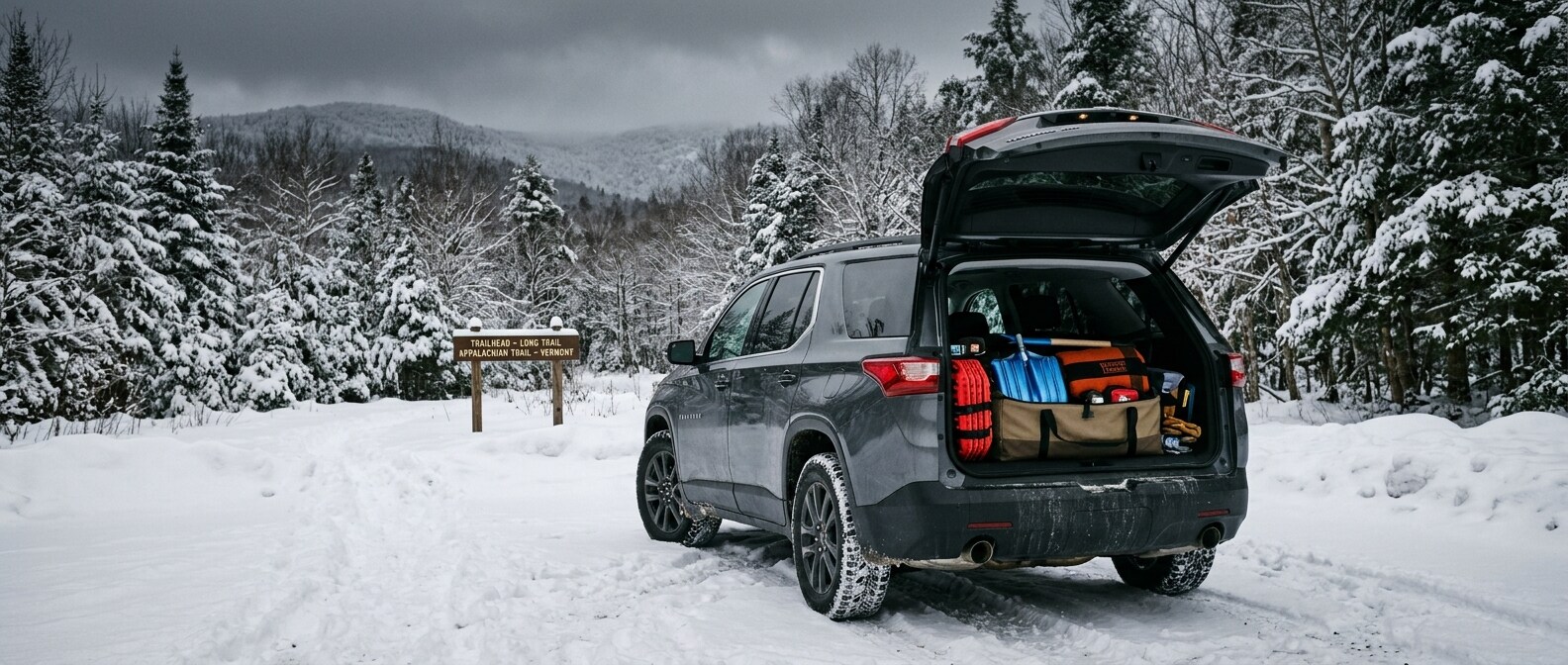
Vermont doesn't promise bare roads. The state runs a safe-roads-at-safe-speeds policy, and plow routes here average one and a half to two hours to finish. So every drive from November through March carries a real window when the road under your tires hasn't been touched yet. Think of this as the honest frame for the list. No doomsday kit here, just what every Chevrolet in Windham County should carry so a school run, a grocery trip, or a snowshoe outing to the Retreat Trails doesn't turn into an avoidable ordeal.
A three-row Traverse or a compact Trailblazer both have the cargo space to carry this gear without crowding a soul. Pack it once in November. Check it in January, and you're set.
What Goes on the Checklist?
The checklist below splits into six categories, from warmth to first aid, and every item on it earns its space in your cargo area. Work through it one group at a time.
Warmth
- Emergency mylar blanket (folds to wallet size, holds body heat well)
- Wool or fleece layer, hat, gloves, and wool socks (cotton holds moisture and loses its insulating value when wet. Skip it)
- Hand warmers, chemical, at least four
Visibility and signaling
- Long-handled ice scraper and snow brush (keep this in the cabin, not the trunk, a frozen trunk latch is a real thing in Vermont January)
- Road flares or LED reflective triangles
- A brightly colored cloth or flag tied to the antenna or door handle
Traction and extraction
- Compact folding snow shovel
- Sand or non-clumping cat litter (a coffee-can's worth does real work under a spinning tire)
- Traction mats or boards (optional but worth carrying if you park at unpaved lots)
Power and communication
- Portable lithium jump starter, fully charged (cold chemistry means a battery that tested fine in October can struggle at single-digit temperatures. More on that below)
- USB power bank for the phone
- 12-volt or USB charging cable that fits your phone
Sustenance
- One liter of water, in a metal or glass container (plastic bottles can crack in deep cold)
- Energy bars, dried fruit, or nuts
First aid and tools
- Basic first-aid kit with any personal medications you need on the road
- Multi-tool or basic wrench and screwdriver set
- Tow strap or rope
Why the Key Items Matter Here
Most of these items matter in any cold climate, but a handful earn extra attention in southern Vermont because our conditions are specific, and a few of them need a word of context before you pack. Generic winter kit guides write for every state. We'd rather tell you how this gear behaves on a Windham County February morning.
The jump starter is not optional. A car battery loses about 30 percent of its capacity when temperatures drop to freezing, and closer to 50 percent at zero degrees. Southern Vermont sees overnight lows well below zero in January and February. The battery that started the truck easily in October is working twice as hard on a February morning before you've run the defroster for thirty seconds. In our experience, deep cold snaps bring this pattern out reliably. A battery that tests borderline in the fall crosses the line the first real cold week. Schedule a battery check before the cold settles in, and carry the jump starter for the stretch between service visits.
Keep the scraper in the cabin. This one sounds small, and it isn't. Trunk latch mechanisms freeze. Trunk latches freeze. If you need a scraper and the scraper is locked in a trunk you can't open, you've started the morning badly. Keep it in the rear seat footwell or in the cargo area behind the last row, wherever you can reach it without opening the trunk.
Tire pressure drops with temperature, every time. About one PSI for every ten-degree drop in temperature. If your tires were inflated properly at 50 degrees in October, they're running low when the January mercury reads ten. Underinflation cuts traction and speeds up tire wear, both bad news on a road that may still have snow on it when you're driving. Check the placard on the door jamb for the correct cold-inflation number, and check it on the first genuinely cold morning of the season. Don't wait for a warm day at the pump.
Vermont roads have snow on them during storms. The state's policy explicitly allows roads to carry some snow cover while a plow route is in progress, and those routes average an hour and a half to two hours. You'll drive road that hasn't been touched yet. The traction materials (sand, cat litter, traction mats) handle a soft shoulder or a low spot in a lot. They won't carry you through a full highway emergency. Pack them for the parking lots and dirt sections.
A local note from our team: The Retreat Trails trailhead draws snowshoers and cross-country skiers all winter. A free, open network with roughly ten miles of paths sits right on the north edge of town. Folks come back from an hour on trail to a car that's sat in cold that dropped further while they walked. A frosted windshield, a cold-soaked battery, and a trunk full of snowshoe gear with no scraper in reach make a predictable combo. Pack the kit before the first real snowfall. The trails aren't going anywhere, and the cold isn't either.
An Equinox makes an easy daily driver for this kind of errand-to-trailhead routine, and a Silverado 1500 bed carries all of this gear without touching cab space at all.
Next step: If your Chevrolet hasn't had a pre-winter inspection yet, now's the time. Battery, tires, wipers, and washer fluid all deserve a look before the temperature drops for good.
Schedule Your Pre-Winter Service Check
A Few Items That Surprise People
A few items on this list are easy to misjudge, so we broke them out item by item in the table below.
| Item | Why it matters in Vermont specifically |
|---|---|
| Portable lithium jump starter | Cold slashes battery capacity; cable-only approach requires a second car that may not be nearby on a rural road |
| Wool/synthetic clothing layer | Cotton retains moisture when you sweat in cold; wool and synthetics insulate even when wet |
| Folding snow shovel | Snow accumulates fast on parking lots that plow service hasn't reached; a shovel clears you in minutes |
| Non-clumping cat litter or sand | Gives tire traction on ice or packed snow when you're stuck; cheap, light, never expires |
| Water in glass or metal | Plastic water bottles crack in deep cold; metal or glass holds up overnight in a sub-zero cargo area |
| Scraper in the cabin | Frozen trunk latch makes trunk-stored tools unreachable on the worst mornings |
| Tow strap | A neighbor or passing plow operator can pull you out quickly if you have one; without it, the wait is longer |
A note on what this kit can't fix. Good tires are the prerequisite. No amount of cat litter matters if your tread is gone. All-wheel drive helps with traction, though it won't do the job on its own. Our service team will tell you the same thing on the lot. The kit in the cargo area is the backup, not the plan.
The Print-and-Go Recap
Pull this list out in October, check off each item, and pack it in a small plastic bin that sits in the cargo area. That bin stays there all winter.
Always in the cabin, within reach without opening the trunk:
- Ice scraper and snow brush
- Phone charging cable
Always in the cargo area or truck bed:
- Mylar emergency blanket
- Wool or fleece layer, hat, gloves, wool socks
- 4+ chemical hand warmers
- Compact folding shovel
- Sand or cat litter (small bag or coffee can)
- Portable lithium jump starter (charged)
- USB power bank (charged)
- 1 liter of water in metal or glass
- Energy bars or non-perishable snacks
- First-aid kit with any personal medications
- Road flares or LED reflective triangles
- Brightly colored cloth or flag
- Tow strap or rope
- Multi-tool
One check each November. One check in January after the first deep cold snap to confirm the jump starter and power bank are still charged, and you're done.
Our service team is on Putney Road and can inspect your battery, tires, wipers, and washer fluid before the season gets serious.
Frequently Asked Questions
What is the single most important item in a Vermont winter car kit?
A portable lithium jump starter is the one item that handles a common Vermont winter failure, a cold-weakened battery. Car batteries lose roughly 30 percent of their capacity at freezing temperatures and closer to 50 percent at zero degrees. A jump starter the size of a paperback book lets you restart the vehicle on your own, which matters most on a rural road where the nearest passing car may be several minutes away. Keep it charged, and bring it inside overnight during the coldest weeks so its own battery stays warm.
Why should I keep the ice scraper inside the car instead of the trunk?
Trunk latches freeze in Vermont winters. When temperatures drop below zero after freezing rain or a hard overnight cold, the mechanism can go entirely unresponsive. If your scraper is in a trunk you can't open, you're scraping with a credit card or a CD case while the windshield slowly defogs from the inside. Store the scraper in the rear seat footwell or behind the last row of seats, somewhere you can reach by opening a passenger door.
Categories:
Social