

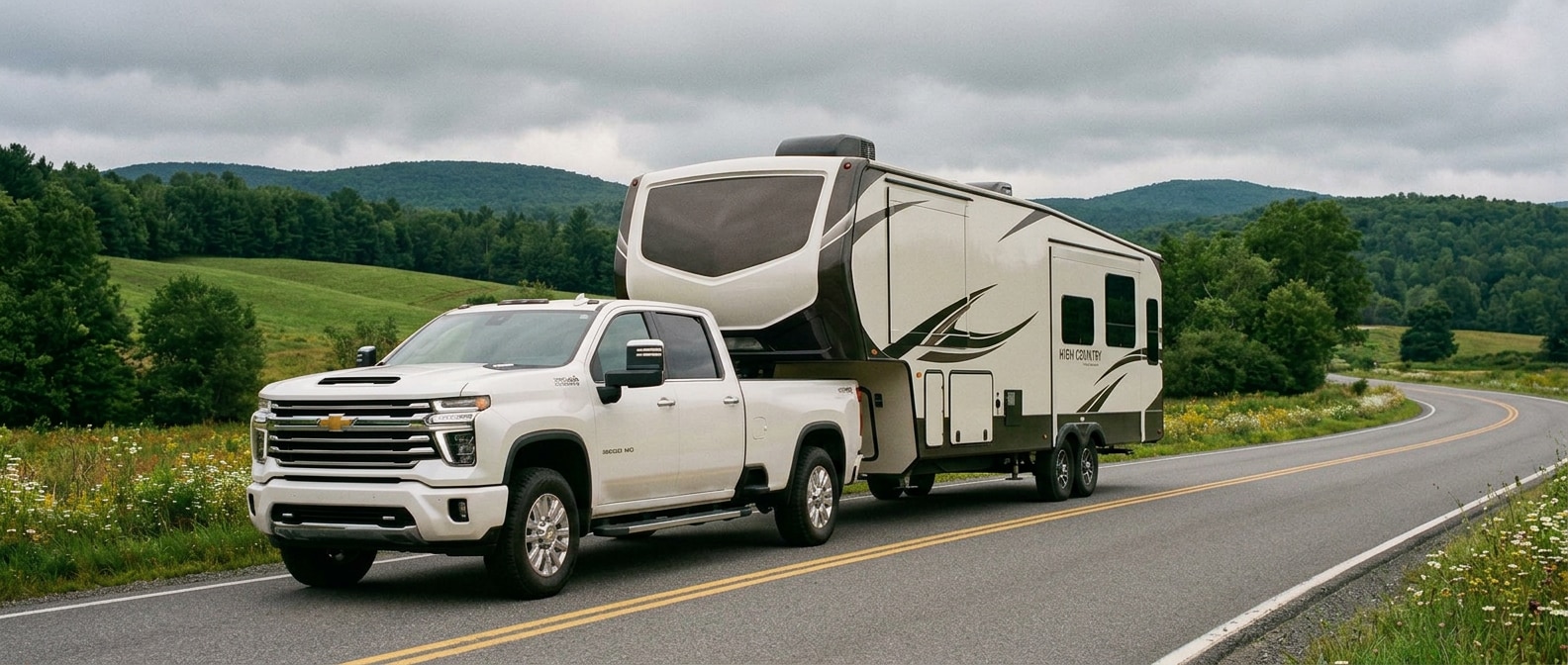
If you're walking in to ask about a Silverado HD, you probably already know a half-ton won't cut it for what you're pulling. The harder call is which HD, the 2500 or the 3500. We'll give you a straight answer. For most southern Vermont buyers hauling a camper, a landscape trailer, or light equipment, the Silverado 2500 HD is more truck than enough. When you're regularly creeping toward 20,000 pounds or need serious payload in the bed while you tow, that's when the Silverado 3500 HD starts to earn its keep.
The short version
- The 2026 Silverado 2500 HD tows up to 18,500 lbs (gas V8) or up to 20,000 lbs (Duramax diesel), when properly equipped, per Chevrolet's published capability guide
- The 2026 Silverado 3500 HD reaches up to 36,000 lbs when configured with the Duramax diesel and dual rear wheels
- The 3500 HD is the only HD Silverado that offers a dually (dual rear wheel) setup, which also raises the payload ceiling to up to 7,442 lbs
- The integrated trailer brake controller is now standard on every 2026 Silverado HD trim, gas or diesel
- For most Brattleboro-area families and small trades, the 2500 HD hits the sweet spot between real capability and everyday maneuverability
What's the Real Difference Between the 2500 HD and 3500 HD?
The two trucks share a cab, the same pair of engines, and the same basic profile, so from ten feet away you'd be hard-pressed to tell them apart. Where they split is capability. Chevrolet lists the 2026 Silverado 2500 HD at a maximum conventional tow rating of 18,500 lbs with the gas V8, or up to 20,000 lbs with the available 6.6L Duramax turbo-diesel, when properly equipped with the right hitch package. Configure the 2026 Silverado 3500 HD with the Duramax diesel and the dual rear wheel (dually) setup and it reaches up to 36,000 lbs. That gap isn't a rounding error. It's a different class of machine.
| Spec | 2026 Silverado 2500 HD | 2026 Silverado 3500 HD |
|---|---|---|
| Max conventional tow (gas V8) | ~14,500 lbs | Up to 18,500 lbs |
| Max conventional tow (Duramax diesel) | Up to 20,000 lbs | Up to 36,000 lbs (dually) |
| Max payload | Up to 3,979 lbs | Up to 7,442 lbs |
| Dual rear wheel (dually) option | Not available | Available |
| Engine options | 6.6L Gas V8 or 6.6L Duramax | 6.6L Gas V8 or 6.6L Duramax |
| Integrated trailer brake controller | Standard, all trims | Standard, all trims |
All figures apply when properly equipped. Check the door-pillar sticker for the actual limits on your specific truck, and cross-reference Chevrolet's published capability guide.
The 3500 HD's game-changer is the dually option: dual rear wheels unlock both the highest tow ratings and the payload ceiling that commercial operators and serious RVers need.
Does the Dually Actually Matter for How You Tow in Vermont?
The paper numbers only tell you so much, so let's talk about how a dually behaves when there's real weight behind it. A second wheel on each side spreads the load and fights trailer sway better, which adds meaningful stability when you're pulling a very heavy gooseneck or fifth wheel. For a Vermont buyer consistently hauling 20,000-plus pounds of equipment or livestock? It matters. A lot.
But there's a genuine tradeoff we think is worth naming plainly. A dually is wider than a standard single-rear-wheel truck. On Route 30 north through the West River valley, where the two-lane narrows past old farms and the shoulder disappears on the corners, you'll feel that extra width. Dually trucks ask for a little more spatial awareness in tight campgrounds, at the dump, and on the kind of dirt town roads that go soft in April. None of that is a reason to skip the 3500 HD if you truly need it. It's a reason to be straight with yourself about whether you do.
For most families towing a travel trailer under 15,000 lbs, or a contractor running a landscape trailer and occasionally hauling mulch, the single-rear-wheel 2500 HD is easier to live with day-to-day and gives up nothing in practical capability.
Which Engine Should You Choose: Gas V8 or Duramax Diesel?
Both the 2500 HD and the 3500 HD offer the same two engines, the 6.6L gas V8 (401 horsepower, 464 lb-ft of torque) and the 6.6L Duramax turbo-diesel V8 (470 horsepower, 975 lb-ft of torque). Both pair with a 10-speed automatic transmission, and the Allison unit is reserved for the Duramax.
Torque is where the two engines truly part ways. Chevrolet's engineering data shows the Duramax makes its torque peak early in the RPM range, which translates to confident trailer starts on an incline and less transmission hunting on a sustained grade. The gas V8 peaks its torque higher up the rev range. That leaves it a touch less relaxed under heavy sustained load, though still entirely capable for most work.
Heavy-duty trucks aren't EPA-rated for fuel economy, so any fuel-consumption comparison leans on real-world estimates rather than official figures. Owner reports put the gas 6.6L somewhere in the 11 to 14 MPG range combined, while the Duramax diesel tends to return better numbers under load. Going diesel adds Diesel Exhaust Fluid (DEF) maintenance, a diesel particulate filter, and pricier service intervals. The gas V8 carries one clear edge in a Vermont winter, starting and responding predictably in extreme cold with no fuel-gelling concerns and simpler cold-start behavior. The gas engine also sits lighter over the front axle, which can nudge payload ratings up a bit on a given configuration.
Our team's practical read: if you tow regularly and heavily, the Duramax pays for itself in long-haul fuel savings and grade composure. If you tow a camper a few times a year and use the truck for everything else in between, the gas V8 is plenty of engine and a better fit for Vermont winters.
The Towing Technology That Comes Standard in 2026
One 2026 change that doesn't get enough attention is the integrated trailer brake controller, now standard across every Silverado HD trim. No more aftermarket unit wired in under the dash. The in-dash controller lets you set trailer brake gain directly, and that's exactly the kind of feature that saves you time at the start of every trip.
"Chevrolet's 2026 Silverado HD incorporates several systems that improve visibility, simplify setup, and monitor your trailer while driving." - Chevrolet capability guidance
Beyond the brake controller, the 2026 Silverado HD offers up to 14 available camera views. Those include a Hitch View for lining up ball and coupler on the first try, a Transparent Trailer View that stitches images to virtually see through your trailer during lane changes, and a Bed View for checking gooseneck connections without leaving the cab. The In-Vehicle Trailering App stores trailer profiles, so pre-trip checks get faster and more consistent over time. Trailer Sway Control runs quietly in the background through StabiliTrak.
None of these features replace proper setup. Aim for tongue weight around 10 to 15 percent of total trailer weight, and remember your actual capacity is always the number on the door-pillar sticker, not the headline figure in a brochure.
So Which Should You Pick?
It comes down to what you're actually pulling and how close to the ceiling you expect to run. Buy by buyer profile:
You want the 2500 HD if you're towing a travel trailer, fifth wheel, horse trailer, or equipment trailer in the 8,000 to 18,000 lb range and you don't need the payload ceiling of a dually. The size stays manageable on Vermont's narrow roads, it parks and maneuvers like a normal truck, and Chevrolet rates it to handle everything most property owners and small trades in Windham County actually haul. The gas V8 suits seasonal towing and hard winters well. The Duramax makes sense when you're near the upper end of the weight range on a regular basis.
You want the 3500 HD if you're pulling a commercial gooseneck, heavy construction equipment, or a large livestock trailer consistently above 20,000 lbs. Same goes if your payload demands are serious (think a truck-mounted service body or a bed fully loaded with materials while you're also towing). The dually's extra stability at extreme weights is real, and the 3500 HD's payload ceiling of up to 7,442 lbs sits in a different category from the 2500 HD.
Here's the tradeoff worth naming. The 3500 HD is a purpose-built tool for the heaviest jobs, and using it for lighter work means living with a wider footprint every day without ever drawing on the extra capability. For southern Vermont's typical buyer, that's often a trade that doesn't pencil out. Browse what we've got in both configurations, and let's talk through what you're actually pulling.
Frequently Asked Questions
Does the 2026 Silverado 2500 HD have the same engine options as the 3500 HD?
Yes. Both the 2026 Silverado 2500 HD and the 2026 Silverado 3500 HD offer the same two powerplants: the 6.6L gas V8 (401 hp, 464 lb-ft of torque) and the 6.6L Duramax turbo-diesel V8 (470 hp, 975 lb-ft of torque). Both pair with a 10-speed automatic transmission. The key difference is that the Duramax version uses an Allison-sourced transmission, while the gas V8 uses a standard heavy-duty 10-speed unit. The engine choice affects your towing ceiling, payload rating, and real-world behavior under load, so it's worth matching the powertrain to how often and how heavily you tow.
What does "properly equipped" mean on the towing spec sheet?
It means the rated number only applies when your specific truck has the right combination of cab style, bed length, drivetrain, hitch type, and any required towing package (such as the Max Trailering Package or the 5th Wheel/Gooseneck Hitch Prep Package). A Crew Cab with a standard bed and 4WD will have a different rating than a Regular Cab with a long bed and 2WD, even with the same engine. The authoritative number for your truck is on the door-pillar sticker, not the brochure headline. Always verify there before loading up and heading out.
Categories:
Social