

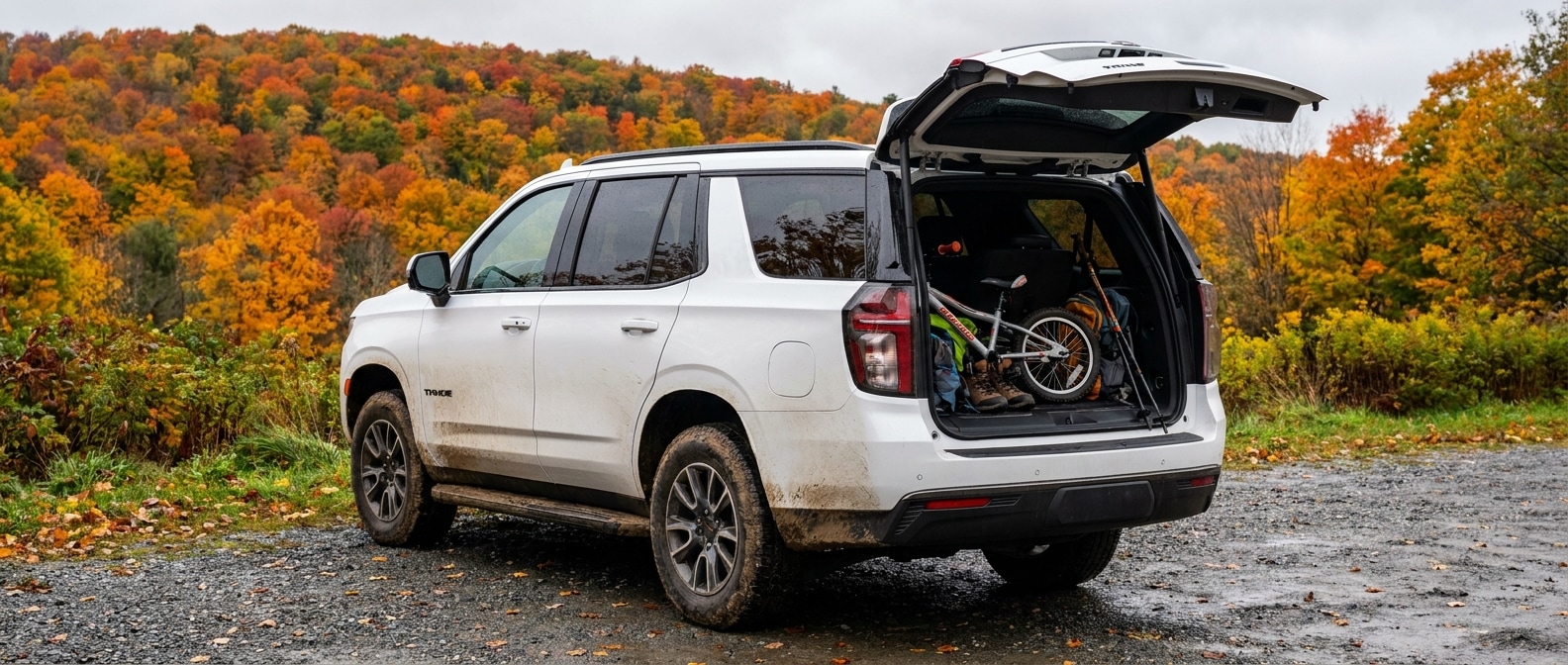
When southern Vermont families come to us for a Tahoe, the truck itself is rarely the problem. The configuration is. A rear-wheel-drive Tahoe on a dirt town road in late March makes for a rough day. Pick the 5.3L V8, then commute 60 miles a day, and you're paying a real fuel penalty the diesel option would have eased. The 2026 Chevrolet Tahoe is an excellent vehicle for this market. Getting the trim, drivetrain, and engine right for Vermont's actual conditions is what separates a great ownership experience from an expensive frustration.
Browse our 2026 Tahoe inventory in Brattleboro
What's Actually Going Wrong When a Vermont Family Buys the Wrong Tahoe?
Southern Vermont puts a full-size SUV through conditions a generic family buyer's guide won't touch, and mud season alone turns plenty of town roads into something that demands real traction management, so a wrong-spec Tahoe tends to reveal itself out on the road well after the sale. The table below sorts the common symptoms.
| Vermont Driving Symptom | Likely Cause | What to Do |
|---|---|---|
| Spinning or sliding on a soft dirt road in April | Rear-wheel drive standard on LS, LT, RST, Premier trims | Add 4WD option or choose the Z71 (standard 4WD) |
| High fuel costs on a long daily commute | 5.3L V8 at EPA-estimated 15 city (forward slash) 19 highway with 4WD | Consider the 3.0L Duramax diesel (20 city, 24 highway, 4WD, EPA-estimated) |
| Not enough cargo room when ski gear fills the third row | Choosing the Tahoe when you need seats and cargo simultaneously | Know the 25.5 cu ft behind the third row; fold or remove the row for gear |
| Underbody scraping on the access road to a trailhead or seasonal camp | Standard suspension approach angle on non-Z71 trims | Z71 adds skid plates, all-terrain tires, and a high-approach-angle front fascia |
| Kids and hockey gear but no room to tow the camper | Not speccing the Max Trailering Package | Add the package; properly equipped, the Tahoe tows up to 8,400 pounds |
Drivetrain Is the First Decision, Not the Last
Drivetrain sits at the top of the list in Vermont, well ahead of paint and trim, because the 2026 Tahoe comes standard with rear-wheel drive on every trim except the Z71, and on a slushy grade that one spec decides how the whole morning goes. So it's the first thing we work through with families here.
You add 4WD as an option on the LS, LT, RST, and Premier trims. A lot of families assume a truck-based full-size SUV automatically arrives with 4WD, and it doesn't. The Z71 is the one trim where 4WD is standard (Chevrolet lists it as such in the lineup specification), and it bundles a two-speed Autotrac transfer case, skid plates, and all-terrain tires.
For a family running the school drop at Brattleboro Union High School on Fairground Road on a slushy February morning, 4WD isn't optional; it's the gap between confident and anxious. And when a dirt road goes soft enough in April to rut under a loaded SUV, the Z71's skid plates and all-terrain rubber earn their keep well beyond the performance optics.
Not sure full-size is right? Compare the Chevy Traverse
That said, 4WD is an aid, not a guarantee. AWD, 4WD, and traction-control systems improve your ability to get moving in low-traction conditions. They don't shorten your stopping distance. In mud season and on packed snow, slow down and leave more following distance no matter which drivetrain you picked.
The Diesel Question Every Vermont Commuter Should Ask
If your daily drive runs 40 miles or more each way, the 3.0L Duramax turbodiesel earns a serious look, though for a low-mileage year it won't pay you back. So the answer really turns on how far you drive.
The EPA rates the diesel 4WD Tahoe at 20 city and 24 highway. The standard 5.3L V8 with 4WD rates 15 city and 19 highway, per EPA estimates. That 5-mpg highway difference isn't a small thing over a Vermont commuting year. The diesel also produces 495 pound-feet of torque (Chevrolet specs), and that torque arrives low in the rev range. A loaded pull up a grade feels effortless in a way the already-capable V8 can't quite match.
The trade-off is real. The diesel adds cost upfront, and if you drive relatively few miles per year (say, a seasonal property owner who isn't commuting daily), the V8 makes more economic sense. The 5.3L V8 makes 355 horsepower and 383 pound-feet of torque, per Chevrolet. It's a genuinely strong engine, and a fine choice for this market. It simply isn't the optimal one for a daily 60-mile round trip through Windham County.
Both engines pair with 4WD here in Vermont. The choice comes down to your annual mileage.
Our team's note: The Brattleboro-to-Keene run is exactly the kind of commute where engine choice matters, and the diesel's range advantage on a 24-gallon tank is a real factor. We'll run the numbers with you based on your actual commute pattern rather than a generic scenario.
The Vermont Tahoe Configuration Checklist
Before you build your Tahoe on the configurator, walk through the four questions below, because the costly mistakes tend to trace back to a spec skipped at order time rather than a bad vehicle, and each answer points to a concrete option. Take them one at a time.
- [ ] Is your primary route paved, dirt, or mixed? (Dirt or mixed: add 4WD, or choose Z71)
- [ ] Do you drive more than 40 miles each way daily? (Yes: price out the diesel option seriously)
- [ ] Will all three rows be occupied AND will you carry ski gear or sports equipment? (Tahoe gives you 25.5 cu ft behind the third row; the Chevrolet Suburban adds meaningful cargo depth if you need both seats and a full load)
- [ ] Do you tow a camper, trailer, or boat? (Verify towing needs against the door-pillar label; the Tahoe is rated up to 8,400 pounds when properly equipped per Chevrolet's capability guide)
When to Handle It Yourself Versus Talking to Our Team
Some of these calls you can make on your own, and a few genuinely reward sitting down together, so the split runs between the drivetrain question, which answers itself the moment your road turns to dirt, and the engine-and-trim question, which is worth a little shared math. If your road is dirt and you're in southern Vermont, you add 4WD, and that part's done.
When you're comparing the Z71 to a 4WD-optioned Premier or LT, the Z71 brings off-road hardware the Premier lacks, meaning skid plates, all-terrain tires, and the Autotrac two-speed transfer case. The Premier adds comfort content the Z71 doesn't include as standard. Which one fits your use case depends on whether you spend more time on unmaintained roads or on the interstate. Our service team also sees what deferred maintenance does to Tahoes that have logged years on salted Vermont roads. Rustproofing and undercoating at the point of purchase is a conversation worth having before you pick up the keys rather than after the first winter.
A few more questions are worth asking yourself before you configure.
- Parking and maneuverability: Will you park in downtown Brattleboro or tight school lots? The Tahoe is more maneuverable than the Suburban; still longer than a midsize crossover; have realistic expectations.
- Seasonal road access: Does your seasonal commute include the West River Trail access or similar unmaintained seasonal roads in spring? The Z71's skid plates and ground clearance are truly useful here, not just cosmetic.
- Winter mornings: Are winter mornings your biggest concern? Heated second-row seats, remote start, and 4WD are the three features that earn their keep on a Vermont February morning.
Schedule a service consultation at Brattleboro Auto Mall Chevy
Frequently Asked Questions
Is the 2026 Chevrolet Tahoe a good choice for Vermont winters with a family?
Yes, with the right configuration. The 2026 Tahoe offers available 4WD on all trims and standard 4WD on the Z71, which is the configuration we recommend for Vermont families dealing with dirt roads, mud season, and winter grades. The platform is body-on-frame (the same architecture as a pickup truck), which gives it genuine capability in low-traction conditions. The honest caveat: 4WD helps you move; it doesn't help you stop. Reduce speed and increase following distance on snow and ice regardless of drivetrain.
Does the Tahoe's third row actually work for teenagers on long Vermont drives?
It does, but it depends on the second-row configuration. The 2026 Tahoe offers up to 122.7 cubic feet of total cargo volume with seats folded, and about 25.5 cubic feet behind the third row when all seats are up. With the standard bench seat in the second row, third-row access is easier. Captain's chairs in the second row (available on several trims) improve comfort but reduce seating capacity. For a family of five or six with teenagers, the cabin is truly usable for a holiday drive to Burlington or a ski day. For families who need seven or eight seats and significant cargo behind them simultaneously, the Suburban's additional length provides meaningfully more room.
What's the maintenance story on a Tahoe in a salt-heavy Vermont climate?
Regular rust prevention is the key factor. Rustproofing and undercoating at the point of purchase, applied before your first winter, protect the undercarriage from accelerated corrosion caused by road salt. Our service team sees vehicles that deferred this step encounter significant rust issues by year three or four on salted roads. Beyond that, standard maintenance intervals apply. If you're buying a 2026 Tahoe for Vermont year-round use, treat rust prevention as non-optional.
Categories:
Social